Your money is supposed to work for you — but if it’s sitting in a regular savings account at a traditional bank, it’s barely moving at all. Most big banks still pay somewhere around 0.37–0.38% APY, which means $10,000 left there for a year earns you less than the price of a decent dinner. Here’s the good news: you don’t have to accept that. High-yield savings accounts (HYSAs) — offered by online banks and credit unions — are currently paying between 3% and just over 4% APY, on the exact same kind of account, with the exact same FDIC protection up to $250,000.
No extra risk, no lock-in period, just a much better return for doing nothing differently except choosing the right bank. And right now is actually a good time to be looking. After two years of falling rates, the Federal Reserve just raised its benchmark rate for the first time since 2023 — which means savings yields are starting to climb again instead of shrink. This guide walks through the top-paying HYSAs available today, what’s actually behind the rate you’re offered, how these accounts stack up against CDs and money market accounts, and how to pick the one that fits how you actually save. How to Start Investing with $500: Beginner’s Guide
What Is a High-Yield Savings Account?
A high-yield savings account is a savings account, usually offered by an online bank or credit union, that pays a significantly higher interest rate than the accounts offered by traditional brick-and-mortar banks. The mechanics are identical to a regular savings account — you deposit money, it earns interest, and you can withdraw it — but the yield is often 8 to 11 times the national average because online banks have lower overhead costs (no branch network, fewer staff, lower real estate costs) and pass much of that savings on to customers in the form of higher rates.
HYSAs are designed for holding money you don’t need to spend immediately — an emergency fund, a house down payment, or savings for a near-term goal — rather than everyday transactions. Most limit convenient withdrawals, though federal rules that once capped withdrawals to six per month were relaxed in 2020, so check each bank’s specific policy.
Why Rates Are Moving Again in 2026
Savings rates aren’t fixed — they track the Federal Reserve’s benchmark rate, known as the federal funds rate. Banks adjust what they pay depositors based on what it costs them to borrow money elsewhere, so Fed policy moves ripple through to your savings account within weeks.
After the Fed cut rates several times through late 2024 and 2025, bringing its target range down to 3.50–3.75%, it reversed course. On September 16, 2026, the Fed raised the federal funds rate by 25 basis points to a target range of 3.75–4%, its first hike in more than three years, aimed at addressing inflation still running above its 2% target.
Several online banks — including American Express, Bask Bank, E*TRADE, Ivy Bank, Marcus, TAB Bank, Valley Bank, and Vio Bank — raised their savings rates in response, and none on major comparison lists have cut theirs since. That means HYSA shoppers currently have some leverage: rates are trending up, not down, for the first time in a couple of years.
Top High-Yield Savings Accounts Right Now
Rates below are current as of late September 2026, pulled from multiple comparison sources (NerdWallet, CNBC Select, Yahoo Finance, Experian). Always verify the exact rate on the bank’s own site before opening an account, since APYs change without notice.
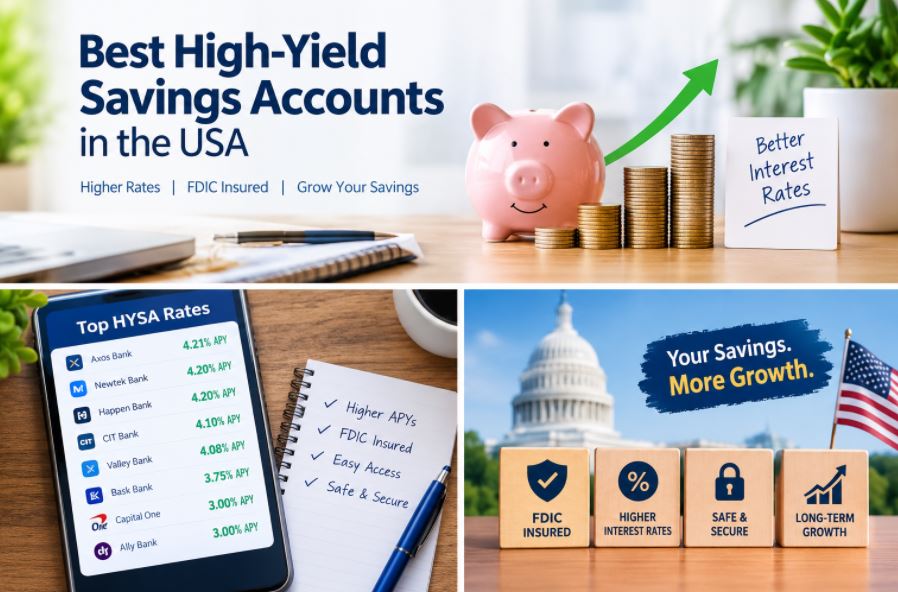
| Bank | APY | Requirements | Min. Opening Deposit |
|---|---|---|---|
| Axos Bank (Axos ONE Savings & Checking) | Up to 4.21% | Linked Axos checking account, plus either a $1,500 avg. balance with $1,500/month direct deposit, or a $5,000 avg. balance with $5,000/month in transfers | $0 |
| Newtek Bank (Personal High Yield Savings) | 4.20% | No monthly fee | $0 |
| Happen Bank (LevelUp Savings) | 4.20% | Requires $250/month in deposits | $0 |
| CIT Bank | 4.10% | Varies by product tier | Varies |
| Valley Bank | 4.08% | Fewer requirements than Axos | $0 |
| Bask Bank (Interest Savings) | 3.75% | No minimum deposit, no monthly fee | $0 |
| Capital One 360 Performance Savings | 3.00% | Applies to all balances, no minimum | $0 |
| Ally Bank Savings | 3.00% | No minimum deposit, round-up and auto-save tools | $0 |
| American Express High-Yield Savings | 3.00% | No minimum opening deposit or balance | $0 |
A word of caution on “up to 10% APY” headlines: Some smaller credit unions advertise very high teaser rates, but these are almost always capped on a small balance. One example: a 10% APY that only applies to the first $1,000, with anything above that earning just 0.10% — well below the industry average. These accounts are also often limited to residents of a specific state, and some cap eligibility by age (for example, offering the top rate only to minors or young adults). Read the terms carefully before choosing an account based on a headline number alone.
A Closer Look at the Top Contenders
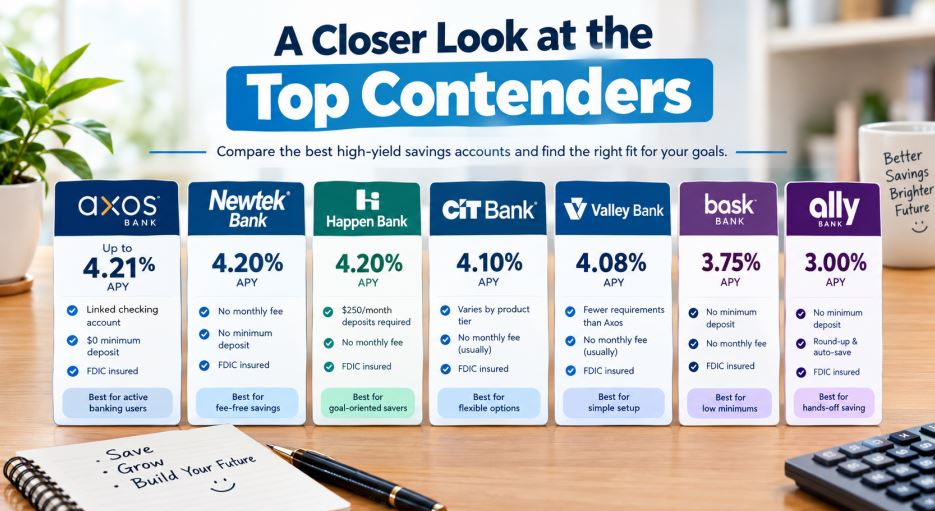
Axos Bank currently tops most rate comparisons at up to 4.21% APY, but that top tier isn’t automatic — you need a linked Axos checking account and either meet a direct deposit threshold or maintain a higher average balance. For savers who can meet those conditions, it’s currently the strongest return on this list. For those who can’t, the effective rate drops.
Newtek Bank and Happen Bank both sit at 4.20% APY with fewer strings attached. Happen Bank’s requirement is a modest $250/month in deposits, which is achievable for most regular savers without needing a linked checking account elsewhere.
Ally Bank and Capital One 360 trail on raw rate (3.00%) but are popular for a reason: zero minimums, zero fees, well-reviewed mobile apps, and tools like automatic round-ups and “safe-to-save” transfers that help people save passively. For many people, the convenience and lack of friction outweighs the roughly 1-point rate difference versus the top payers.
Pros and Cons of High-Yield Savings Accounts
Pros
- APY often 8–11x the national average
- FDIC or NCUA insured up to $250,000
- No market risk — principal doesn’t fluctuate
- Many accounts have no monthly fees or minimum balance
- Funds remain liquid and accessible, unlike CDs
- Some accounts include savings automation tools (round-ups, auto-transfers)
Cons
- Rates are variable and can drop if the Fed cuts rates again
- Top rates often require direct deposit or linked checking accounts
- Most online banks don’t offer physical branches, and some lack ATM cards
- Interest earned is taxable as ordinary income
- Some accounts cap the high rate at a certain balance tier
- Transfers to/from external banks can take 1–3 business days, unlike an in-branch withdrawal
How Much Difference Does APY Actually Make?
On a $10,000 balance held for one year:
- At 0.38% (traditional bank): about $38 in interest
- At 3.00% (entry-level HYSA): about $300 in interest
- At 4.20% (top-tier HYSA): about $420 in interest
On a $25,000 balance:
- At 0.38%: about $95
- At 3.00%: about $750
- At 4.20%: about $1,050
$50,000 balance:
- At 0.38%: about $190
- At 3.00%: about $1,500
- At 4.20%: about $2,100
The gap between “convenient big bank” and “high-yield online bank” isn’t trivial — on larger balances, it can mean well over a thousand dollars a year on the same money, with no added risk. These figures assume simple annual compounding for illustration; actual returns will vary slightly since most HYSAs compound daily or monthly. FDIC Official Website
HYSA vs. Other Savings Options
HYSA vs. Traditional Savings Account: Traditional accounts pay far less (often under 0.5% APY) but may offer in-branch service, easier cash deposits, and simpler linking to a local checking account. HYSAs win decisively on pure interest earned, and the “inconvenience” of an online-only bank is minor for most people who mainly need transfers rather than in-person service.
HYSA vs. Certificate of Deposit (CD): A CD locks in a fixed rate for a set term (e.g., 6 months, 1 year, 5 years) and typically penalizes early withdrawal. A HYSA rate is variable but your money stays fully accessible — better for emergency funds or short-term goals where you might need the cash suddenly. CDs can make sense if you’re confident rates will fall and want to lock in today’s rate for a fixed period.
HYSA vs. Money Market Account (MMA): MMAs often offer check-writing or debit card access along with competitive rates, sometimes requiring a higher minimum balance to earn the top tier. HYSAs are usually simpler, with lower or no minimums, but fewer spending features.
HYSA vs. Treasury Bills / Money Market Funds: For larger sums, some savers compare HYSAs to short-term Treasury bills or brokerage money market funds, which can offer competitive yields and, in the case of Treasuries, state tax exemption. These aren’t FDIC-insured the same way, and involve slightly more setup, so they suit savers comfortable with a brokerage account rather than those wanting the simplicity of a savings account.
How to Open a High-Yield Savings Account
- Compare current APYs, fees, and requirements across a few banks (not just the headline rate).
- Confirm the bank is FDIC-insured, or that a credit union is NCUA-insured.
- Apply online — most applications take 10–15 minutes and ask for identification and Social Security number.
- Fund the account via bank transfer, wire, or mobile check deposit.
- Set up direct deposit or recurring transfers if required to earn the top advertised rate.
- Set up account alerts or a recurring calendar check to review the rate every few months, since APYs change without individual notice.
Common Mistakes to Avoid
- Chasing the headline rate without reading the fine print — many top APYs apply only to a capped balance or require direct deposit.
- Ignoring FDIC/NCUA insurance status — always confirm before depositing any amount.
- Forgetting that rates are variable — a 4.20% APY today isn’t guaranteed next year, and can change with little warning.
- Not accounting for taxes — interest is taxable income and will generate a 1099-INT if it exceeds $10 annually.
- Overlooking accessibility needs — if you need an ATM card or occasional branch access, factor that into your choice, not just the rate.
- Keeping too much in savings instead of investing for long-term goals — HYSAs are ideal for short-term cash, not typically the right home for retirement savings meant to grow over decades.
FAQs
Which US banks have high-yield savings accounts?
>>>>>>>>Mostly online banks and credit unions currently Axos Bank, Newtek Bank, Happen Bank, CIT Bank, Valley Bank, Bask Bank, Capital One, Ally Bank, and American Express offer competitive rates.
How much can $10,000 grow in a high-yield savings account?
>>>>>>>>At today’s top rates (around 4.20% APY), $10,000 would earn roughly $420 in a year, compared to just $38 at a traditional bank’s average rate.
Which bank gives 7% interest on savings accounts?
>>>>>>>>Rates that high are rare and usually capped on a small balance or limited to specific account holders — most top mainstream HYSAs currently pay between 3% and 4.21%.
What happens if I put $100,000 in a high-yield savings account?
>>>>>>>>It stays fully FDIC-insured (up to $250,000 per bank) and would earn about $4,200 a year at a 4.20% APY, though some banks pay a lower rate above a certain balance.
Conclusion
High-yield savings accounts are paying meaningfully more than traditional accounts right now, and rates are trending upward following the Fed’s September 2026 hike. Rather than chasing the single highest advertised number, compare the real APY you’d actually earn given your balance and habits, confirm FDIC or NCUA insurance, and check for hidden requirements like direct deposit minimums or balance caps.
From there, opening an account typically takes about 10–15 minutes online, and revisiting your rate every few months ensures you’re not leaving money on the table as the market shifts.