How to Invest in Treasury Bills: Keeping money in a regular savings account can feel disappointing when you want your savings to work harder. However, investing in stocks is not always suitable for money you may need in a few months. This is where Treasury bills can be useful.
Treasury bills, often called T-bills, are short-term government debt securities.
They allow investors to lend money to a government for a limited period and receive the agreed repayment at maturity. In the United States, investors can buy them directly through TreasuryDirect or through eligible banks and brokers. In the United Kingdom, ordinary retail investors have more limited access to Treasury bills, so the buying process differs.
This guide explains how to invest in Treasury bills, how returns work, what fees and risks to consider, and how US and UK investors can approach this investment.
The key is to understand the terms before committing your money. Government-backed does not mean every investment decision is risk-free, and a quoted yield is not the same as a guaranteed profit in every situation.
What Are Treasury Bills?
Treasury bills are short-term securities issued by a government to help finance its borrowing and manage its cash requirements.
In the US, the Department of the Treasury issues Treasury bills through auctions. Common terms include 4, 6, 8, 13, 17, 26, and 52 weeks.
In the UK, Treasury bills are issued by the UK Debt Management Office (DMO). Regular tenders typically cover one-, three-, and six-month maturities, although available terms can vary.
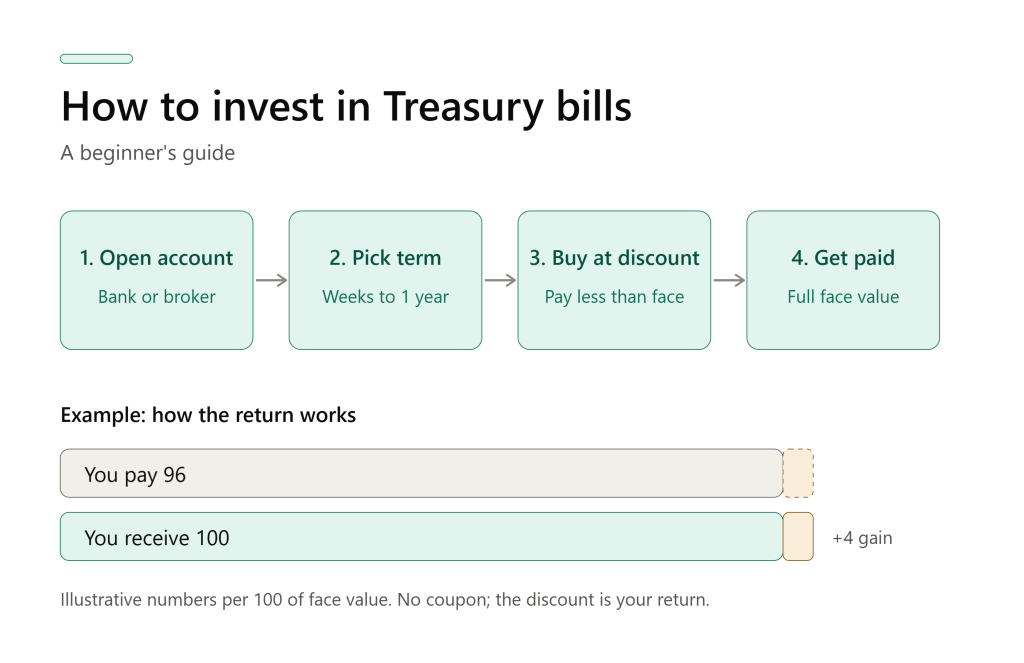
Unlike many traditional bonds, Treasury bills generally do not pay regular interest. Instead, they are commonly sold at a discount to their face value. When the bill matures, the investor receives its face value.
A Simple Treasury Bill Example
Imagine buying a US Treasury bill with a face value of $1,000 for $985.
- Purchase price: $985
- Amount received at maturity: $1,000
- Gross return: $15
Your $15 return is the difference between the purchase price and the amount received at maturity. This is an illustration, not a current market quote. It excludes any applicable fees and taxes.
The actual return depends on the purchase price, maturity date, and the amount paid back. If you sell before maturity, the sale price may be higher or lower than your purchase price.
How to Invest in Treasury Bills in the USA
US investors have two main routes: buying directly through TreasuryDirect or purchasing through a bank or brokerage firm.
Step 1: Choose Where to Buy
TreasuryDirect allows eligible individuals to buy Treasury bills directly from the US Treasury. Alternatively, an investor can use a bank or brokerage that offers Treasury securities.
Direct purchases may suit people who want to hold their bills until maturity. A brokerage can be useful for investors who want to manage Treasury bills alongside other investments or may need the option to sell before maturity.
Before opening an account, check eligibility, account requirements, minimum investment amounts, transfer arrangements, and any broker charges.
Step 2: Decide How Long to Invest
Choose a maturity that matches when you expect to need your money.
For example:
- 4-week bills: Potentially suitable for a very short savings horizon.
- 13-week bills: May suit money needed in approximately three months.
- 26-week bills: Can suit a planned expense about six months away.
- 52-week bills: May suit money that can remain invested for close to a year.
These are examples of time horizons, not recommendations. Allow for settlement dates and keep emergency cash accessible separately. How to Invest in the S&P 500 from the UK (2026)
Step 3: Review the Auction or Available Price
When buying a new Treasury bill at auction, review the offering details and the applicable bidding process. Eligible individual investors can generally place noncompetitive bids through TreasuryDirect, subject to its rules.
A noncompetitive bid allows the investor to accept the auction’s resulting yield rather than specify a minimum acceptable yield. A competitive bid, normally used by institutional investors and submitted through appropriate intermediaries, involves specifying a yield.
If you buy an existing bill through a broker, examine the quoted price, yield, maturity date, and transaction costs before placing an order. Treasury bills for beginners
Step 4: Decide How Much to Invest
Only invest money that you can leave untouched until maturity, unless you understand the risks of selling early.
For example, if you have $3,000 set aside for a bill that matures in three months, first consider whether you need that money for rent, bills, emergencies, or another planned expense.
Do not invest your entire emergency fund just because a Treasury bill offers an attractive yield. Access to cash matters as much as the return.
Step 5: Hold Until Maturity or Review Your Exit Options
At maturity, a Treasury bill pays its face value according to its terms. TreasuryDirect offers reinvestment options for eligible securities, allowing investors to arrange another purchase rather than manually starting over each time.
Reinvestment can help create a simple short-term investment routine. However, the yield on the next bill may be higher or lower than the yield on your current investment.
If you might need the money before maturity, confirm how your provider handles sales and what costs or price changes may apply.
How to Invest in Treasury Bills in the UK
UK investors should understand an important difference: UK Treasury bills are not as straightforward for ordinary investors to buy directly as US Treasury bills.
The UK Debt Management Office states that Treasury bills are predominantly wholesale instruments. At its regular tenders, the stated minimum investment is £500,000 nominal, and members of the public generally need access through a Treasury bill primary participant.
That does not mean every UK retail investor needs £500,000 to gain exposure to short-term UK government debt. It means the direct wholesale tender route is generally unsuitable for a typical small investor.
Option 1: Check Access Through an Investment Platform
Some investment platforms may provide retail access to Treasury bills by aggregating customer orders or offering relevant securities. Availability, minimum amounts, dealing arrangements, and account eligibility vary.
Before investing, ask the platform:
- Is the product an actual UK Treasury bill or a fund holding short-term securities?
- What is the minimum investment?
- Is there a dealing fee, spread, platform charge, or withdrawal restriction?
- Can you sell before maturity, and at what price?
- How are returns and tax reported?
Do not assume that a money market fund or cash fund is identical to owning a Treasury bill directly.
Option 2: Consider UK Government Gilts
For individual investors seeking UK government debt, conventional gilts may be easier to access through a stockbroker, bank, or the DMO’s retail Purchase and Sale Service, subject to its eligibility rules.
Gilts are not the same as Treasury bills. Many gilts pay periodic coupons and have longer maturities. Their market prices can change significantly before maturity, particularly when interest rates move.
If your goal is to hold money for only a few months, compare the maturity, price, income structure, dealing costs, and liquidity carefully before choosing a gilt.
Option 3: Compare Other Short-Term Cash Options
Depending on your circumstances, an easy-access savings account, a fixed-term savings account, or an eligible cash savings product may be more practical.
Compare the rate, access conditions, protection arrangements, and tax treatment rather than choosing a product based on its name alone.
How Do Treasury Bill Returns Work?
Treasury bill returns usually come from the difference between the purchase price and the face value received at maturity.
The purchase price reflects the market’s required return for the bill’s maturity and other market conditions. As interest rates change, the prices and yields of newly issued bills can change too.
Example: Calculating a Treasury Bill Return
Suppose you purchase a bill with a $10,000 face value for $9,850.
Your gross return at maturity is:
$10,000 − $9,850 = $150
Your holding-period return is:
$150 ÷ $9,850 × 100 = approximately 1.52%
This is the return over the bill’s full holding period, not an annual yield. If the bill matures in six months, you should not describe the 1.52% holding-period return as a six-month annual rate without explaining the annualisation method.
For an actual purchase, use the quoted yield and the provider’s calculations. Treasury bills can use specific day-count conventions, so a simple annualisation may differ from the official quoted yield.
Why T-Bill Yields Change
Several factors can affect Treasury bill yields:
- Central bank interest-rate decisions and expectations.
- Demand for short-term government securities.
- Inflation expectations and broader market conditions.
- The maturity date and the amount of time until repayment.
- Government borrowing and cash-management requirements.
A bill bought today does not guarantee that you will receive the same yield when you reinvest in a new bill later.
Treasury Bills vs Savings Accounts and Money Market Funds
These products can all play a role in managing short-term money, but they are not interchangeable.
| Feature | Treasury bills | Savings account | Money market fund |
|---|---|---|---|
| Main purpose | Short-term government borrowing | Holding cash and earning interest | Investing in short-term debt or similar instruments |
| Return | Usually earned through a discount to face value | Interest paid under account terms | Investment income reflected in fund distributions or value |
| Access to money | Generally tied to maturity unless sold | Depends on account terms | Depends on dealing and settlement arrangements |
| Value before exit | Market price can change | Usually stable in nominal terms, subject to product terms | Fund value and income can change |
| Main risks | Market, inflation, reinvestment and operational risks | Inflation and institution or product-specific risks | Credit, interest-rate, liquidity and fund-specific risks |
| Protection | Government obligation, subject to sovereign and currency risks | Depends on country and eligible deposit-protection rules | Not the same as a protected bank deposit |
A US Treasury bill is a direct obligation of the US government. A UK Treasury bill is a direct obligation of the UK government in sterling. Neither should be confused with a fund that holds government securities.
In the US, eligible bank deposits may qualify for FDIC protection within applicable limits and rules. In the UK, eligible deposits may qualify for Financial Services Compensation Scheme (FSCS) protection within applicable limits and eligibility rules. Investment securities and funds are subject to different protections and risks.
Pros and Cons of Treasury Bills
Advantages
1. Short maturities
Treasury bills can be useful when you have a known short-term goal and do not want to commit money for many years.
2. Government credit backing
US Treasury bills are backed by the US government, while UK Treasury bills are sterling-denominated obligations of the UK government. This makes their credit-risk profile different from that of corporate debt, although no investment should be described as free from every possible risk.
3. Clear maturity value
If you hold a bill to maturity, you know its face value and scheduled maturity date when you purchase it.
4. Useful for planned cash needs
A maturity ladder can help investors spread repayment dates across several weeks or months instead of tying all the money to one date.
5. Potential diversification
Treasury bills can complement other investments by adding short-term government debt exposure to a wider portfolio.
Disadvantages
1. Returns can fall when you reinvest
When interest rates decline, newly purchased bills may offer lower yields.
2. Early selling can result in a loss
A bill’s market price may fall if market yields rise. Selling before maturity can therefore produce a loss, especially after transaction costs.
3. Inflation reduces purchasing power
Even when you earn a positive return, inflation may rise faster than your investment return.
4. Access differs between countries
US investors have a direct retail route through TreasuryDirect, while UK investors generally face more restrictions when accessing wholesale Treasury bill tenders.
5. Tax rules can be complex
The treatment of returns depends on tax residence, the security, the account, and local rules. Do not assume the US and UK tax treatments are the same.
What Costs Should Beginners Check?
Treasury bills may have no separate purchase commission on some direct-buying routes, but that does not mean every transaction is cost-free.
Before investing, check:
- Brokerage fees: Some providers charge dealing or transaction fees.
- Bid-ask spreads: When buying or selling an existing bill, the difference between the quoted buying and selling prices can reduce returns.
- Platform charges: A platform may charge account, custody, or administration fees.
- Transfer and withdrawal terms: Settlement arrangements can affect when money is available.
- Taxes: The gross return is not necessarily the amount you keep after tax.
In the United States, Treasury bill earnings are subject to federal tax and exempt from state and local income taxes under the federal Treasury tax rules. Individual circumstances still matter.
In the UK, Treasury bills are not classified as gilts for tax purposes and may fall under the rules for deeply discounted securities. Tax outcomes depend on the circumstances, so check current HMRC guidance or speak to a qualified tax professional.
Do not rely on a generic rate or fee quoted in an older article. Check the current auction results and provider’s fee schedule before placing an order.
Treasury Bill Risks Beginners Should Understand
Treasury bills are often regarded as relatively low-credit-risk investments in their own currency, but they are not suitable for every situation.
Interest-rate risk: If you sell before maturity, market yields may have changed and the price may be lower than you paid.
Inflation risk: The money you receive at maturity may buy less than expected if prices have risen.
Reinvestment risk: You may not be able to reinvest at the same yield.
Liquidity risk: The ease of selling depends on the bill, the market, and your provider. UK retail access in particular can involve restrictions or less convenient exit arrangements.
Currency risk: A UK-based investor buying US Treasury bills takes on US dollar exposure. Changes in the dollar-to-pound exchange rate can increase or reduce the value of the investment when measured in pounds.
Opportunity cost: Money committed to a bill cannot necessarily be used immediately for an unexpected expense.
A sensible approach is to match the maturity date to your goal and keep money for immediate needs in an appropriate accessible account.
A Simple Treasury Bill Strategy for Beginners
You do not need a complicated trading strategy to understand Treasury bills. Start with the purpose of the money.
- Set a clear goal. Identify the amount you need and the date you need it.
- Keep emergency savings accessible. Avoid locking up cash you may need at short notice.
- Compare maturity dates. Select terms that align with your expected spending.
- Compare the net return. Consider the purchase price, yield, fees, taxes, and any currency-conversion costs.
- Consider a maturity ladder. Instead of investing everything in one bill, you could divide suitable funds among bills maturing at different times.
- Review reinvestment decisions. When a bill matures, compare the available yield with savings alternatives before reinvesting.
For example, someone saving for a home expense due in six months might compare a bill maturing near the payment date with an eligible fixed-term savings account. Someone who needs instant access to money may prefer a different option.
The right choice depends on the goal, available products, costs, and the need for access—not simply the highest quoted yield.
FAQs
1. Are Treasury bills safe for beginners?
Treasury bills are generally considered low-credit-risk investments when issued by financially established governments in their own currencies. However, they still carry inflation, reinvestment, market-price, liquidity, and potentially currency risks. They are not a substitute for an accessible emergency fund.
2. How much money do I need to invest in US Treasury bills?
The minimum for marketable Treasury securities purchased through TreasuryDirect is generally $100, with additional purchases in specified increments. Broker minimums and terms can differ, so verify the current rules with your chosen provider.
3. Can I lose money on Treasury bills?
If you hold a bill to maturity and the government pays as promised, you receive the stated face value. However, selling before maturity may result in a loss if the market price has fallen. Inflation can also reduce your real return.
4. How often do Treasury bills pay interest?
Treasury bills generally do not pay periodic interest. They are usually purchased at a discount and pay their face value at maturity. The difference between the purchase price and face value represents the gross return.
5. Can UK residents buy US Treasury bills?
Access depends on the broker, residency rules, account eligibility, and any applicable restrictions. A UK resident should check whether their provider offers US Treasury bills, what fees and currency-conversion costs apply, and how US and UK tax rules affect the investment.
6. Can ordinary UK investors buy UK Treasury bills directly?
The DMO’s regular Treasury bill tenders are predominantly wholesale, with a stated minimum of £500,000 nominal. Individuals generally need to access these tenders through a Treasury bill primary participant. Some platforms may provide alternative retail access, but availability and terms vary.
7. Are Treasury bills better than savings accounts?
Neither option is automatically better. Treasury bills may offer an attractive yield for money that can remain invested until maturity. Savings accounts may be more practical when immediate access and eligible deposit protection are priorities. Compare the current net return, liquidity, fees, and protections.
8. Should I reinvest Treasury bills when they mature?
Reinvestment can be useful if the money is not needed and the new bill’s terms suit your plans. Before reinvesting, compare the new yield with savings accounts and other suitable short-term options. Do not automatically reinvest money you will soon need.
Conclusion
Treasury bills can be a useful tool for beginners who want to understand short-term government debt and plan around a known financial goal. They offer defined maturity dates and a straightforward way to calculate the gross return when held to maturity.
For US investors, TreasuryDirect and eligible brokers provide established ways to purchase Treasury bills. UK investors should understand that the direct Treasury bill market is largely wholesale and investigate the terms of any retail-access platform carefully. UK gilts and savings accounts may be practical alternatives, depending on the goal.
Before investing, confirm the current yield, maturity date, fees, tax treatment, and access arrangements. Start with money you can leave invested, compare alternatives, and choose the option that fits your actual needs rather than chasing the highest advertised return.