The best robo-advisors can make investing easier when you want a diversified portfolio without choosing every stock or ETF yourself. The hard part is choosing the right platform. Fees, account minimums, tax tools, portfolio choices, human support, and retirement features can vary a lot.
A good robo-advisor can handle routine investing while you focus on saving and earning. A poor match can leave you paying for features you do not need or accepting a portfolio that does not fit your goals.
This 2026 guide ranks major U.S. choices first and adds a useful UK comparison. The rankings focus on cost, ease of use, portfolio design, tax features, account access, and the type of investor each platform serves best robo advisor 2026 reddit.
What Are Robo Advisors?
A robo-advisor is an automated investment service that uses your goals, time horizon, financial situation, and risk tolerance to build and manage a portfolio. The platform normally uses diversified funds and can automate rebalancing.
For example, a 30-year-old saving for retirement may answer questions about income, savings, and risk. The robo-advisor can create a portfolio with a mix of stocks and bonds, invest new deposits, and rebalance when the allocation moves away from its target Best Robo Advisors 2026 UK.
Robo-advisors are not guaranteed-return products. Investment values can fall, and fees can reduce long-term returns. The SEC recommends checking the total cost, portfolio strategy, human support, tax features, and the adviser’s registration before investing.
Best Robo Advisors 2026 Ranked
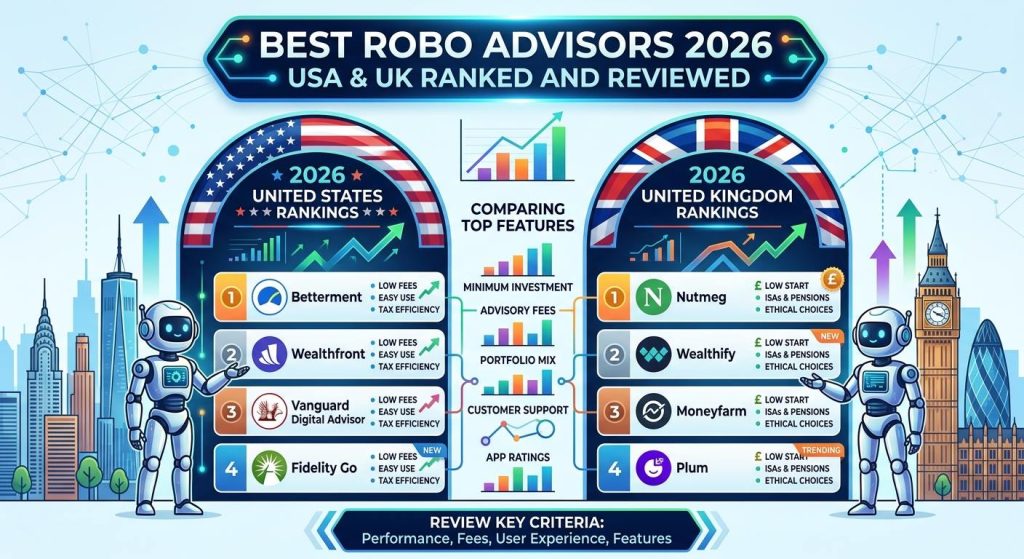
1. Betterment — Best Overall Robo Advisor
Betterment is our overall pick for investors who want goal-based investing, automatic portfolio management, and useful tax features without a large starting balance.
The Digital plan is priced at 0.25% per year or $5 per month, depending on balance and recurring-deposit conditions. There is no required minimum balance for the investment account.
Best for:
- Beginners who want a guided experience
- Retirement and goal-based investing
- Taxable investors who value tax-management tools
- People who want an easy mobile and web experience
Real-world example: An investor starting with $10,000 and adding $300 each month can set a retirement goal and let Betterment handle portfolio allocation and rebalancing.
2. Wealthfront — Best for Tax Optimization
Wealthfront is a strong choice for investors who want more portfolio customization and tax-focused tools. Best robo financial advisor 2026. Its automated portfolios are designed for long-term investing, and the platform is particularly attractive for taxable accounts.
Best for:
- Taxable investment accounts
- Investors interested in tax-loss harvesting
- People who want more portfolio options
- Investors comfortable with a technology-first platform
Real-world example: A high-income investor with a taxable brokerage account may value automated tax management more than access to a human adviser.
3. Fidelity Go — Best for Small Balances
Fidelity Go stands out for investors starting with a smaller account. There is no advisory fee below $25,000. At $25,000 and above, the advisory fee is 0.35% per year.
Best for:
- New investors
- Existing Fidelity customers
- Small starting balances
- Investors who want simple automated management
Real-world example: Someone starting with $5,000 can use Fidelity Go without paying an advisory fee, while still receiving automated portfolio management.
4. Schwab Intelligent Portfolios — Best for Schwab Customers
Schwab Intelligent Portfolios offers automated portfolio management with no advisory fee and a $5,000 starting investment requirement. It can be attractive for investors already using Charles Schwab.
Best for:
- Existing Schwab customers
- Investors with $5,000 or more
- People who prefer a major brokerage ecosystem
- Investors who want automatic rebalancing
One important detail is cash allocation. Investors should understand how much of the portfolio may be held in cash and how that can affect long-term returns.
5. Vanguard Digital Advisor — Best for Low-Cost Vanguard Investing
Vanguard Digital Advisor is worth considering for investors who already prefer Vanguard funds and a long-term, low-cost investing philosophy.
Best for:
- Retirement-focused investors
- Long-term index investors
- Vanguard customers
- People who prioritize low investment costs
Vanguard is especially familiar to investors who prefer broad-market index funds and simple asset allocation.
Robo Advisor Features Comparison
| Robo advisor | Best for | Starting balance | Management fee | Tax tools | Human support |
|---|---|---|---|---|---|
| Betterment | Overall | $0 | 0.25% or $5/month* | Strong | Available on higher plans |
| Wealthfront | Tax optimization | $500 | 0.25% | Strong | Limited |
| Fidelity Go | Small balances | $0 | 0% under $25K; 0.35% after | Moderate | Coaching at qualifying balances |
| Schwab Intelligent Portfolios | Schwab users | $5,000 | $0 advisory fee | Available with qualifying service | Available through Schwab ecosystem |
| Vanguard Digital Advisor | Low-cost index investing | Varies | About 0.20% | Available | Limited |
*Pricing and features can change. Check the provider before opening an account.
Pros and Cons of Robo Advisors
Pros
- Automatic portfolio management
- Diversification without picking individual investments
- Automatic rebalancing
- Lower advisory costs than many traditional advisers
- Simple account setup
- Useful retirement and goal-planning tools
- Tax-management features at some platforms
Cons
- You have less control than with a self-directed brokerage account
- Investment losses are still possible
- Some platforms have limited human advice
- Fund expenses can be separate from the advisory fee
- A low advertised fee does not always mean the lowest total cost
- Complex tax, estate, or business situations may require a human professional
Robo Advisor Performance Comparison
Performance should not be judged by one recent return. A robo-advisor may have a conservative portfolio, while another may use a higher stock allocation. Market conditions can make one look better for a period even when the underlying strategy is different.
| Platform | Performance view for 2026 | Main performance driver |
|---|---|---|
| Betterment | Competitive diversified approach | Stock/bond allocation and tax management |
| Wealthfront | Strong taxable-account focus | Asset allocation and tax optimization |
| Fidelity Go | Designed for long-term diversified investing | Portfolio risk level and Fidelity funds |
| Schwab Intelligent Portfolios | Diversified automated portfolios | Allocation plus cash position |
| Vanguard Digital Advisor | Low-cost long-term approach | Index allocation and low fees |
Past performance does not guarantee future results. Compare portfolios with similar risk levels before deciding which platform performs better.
Robo Advisor Pricing Comparison
| Platform | Advisory fee | Minimum | Notable cost detail |
|---|---|---|---|
| Betterment | 0.25% or $5/month* | $0 | Fund expenses may apply |
| Wealthfront | 0.25% | $500 | Fund expenses may apply |
| Fidelity Go | 0% under $25K; 0.35% at $25K+ | $0 | No trading or rebalancing fees |
| Schwab Intelligent Portfolios | $0 advisory fee | $5,000 | Review cash allocation |
| Vanguard Digital Advisor | About 0.20% | Varies | Fund costs may apply |
Fees matter because even small annual costs reduce the amount of money that stays invested and compounds over time.
What About UK Robo Advisors?
UK investors have different account types and regulations, so the best choice can look different from the U.S. list.
Nutmeg, now part of J.P. Morgan Personal Investing, offers managed portfolios, including fixed allocation, fully managed, socially responsible, and other investment styles. Its current management fees range from 0.75% to 0.25% depending on portfolio style and balance.
Moneyfarm is another UK option with automated portfolio management and human investment support. It currently promotes no management fee on the first £10,000 under its offer, with ETF costs still applying.
For UK investors, compare:
- Stocks and Shares ISA availability
- Pension options
- Management fees
- Fund costs
- Financial Conduct Authority regulation
- Human support
- Withdrawal and transfer rules
U.S. readers should not assume a UK robo-advisor is available to them. For example, Nutmeg’s terms state that it generally provides portfolios to UK residents and does not provide portfolios or services to U.S. persons.
Real-World Example: Which Robo Advisor Fits?
Imagine three investors.
Sarah has $8,000 and is just starting. She wants a simple experience and already uses Fidelity. Fidelity Go may be a strong fit because the advisory fee is zero below $25,000.
Mark has $80,000 in a taxable account and cares about tax efficiency. Wealthfront or Betterment may be more attractive because tax-management features can be valuable.
Lisa has $25,000, already uses Schwab, and wants automated investing. Schwab Intelligent Portfolios may be worth comparing, especially if she understands its portfolio cash allocation.
The “best” robo-advisor depends on the investor, not just the ranking.
Before opening an account, check the fee schedule, minimum balance, portfolio options, tax features, and eligibility rules. Provider pricing can change during the year, so treat the table as a comparison snapshot rather than a fee promise.
FAQs About the Best Robo Advisors
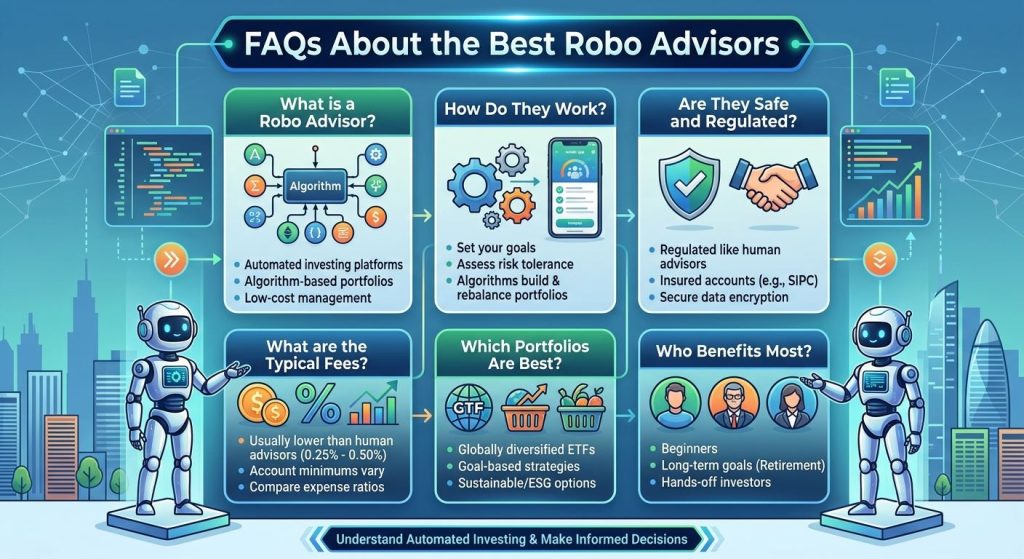
1. What is the best robo advisor in 2026?
Betterment is our overall U.S. pick because it combines simple goal-based investing, automated management, and useful tax features. Wealthfront is a strong alternative for tax-focused investors.
2. Are robo advisors safe?
Robo-advisors are investment services, not guaranteed savings accounts. Your investments can lose value. Check the firm’s registration, account protections, fees, and investment strategy before investing.
3. Can I lose money with a robo-advisor?
Yes. A robo-advisor invests in securities whose prices can rise or fall. A diversified portfolio can reduce concentration risk, but it cannot eliminate market losses.
4. Are robo-advisors cheaper than financial advisors?
They are often cheaper than traditional percentage-based advisory services, but the comparison should include all fees. Look at advisory fees, fund expenses, and any additional service costs.
5. Should beginners use a robo advisor?
A robo-advisor can be useful for beginners who want automatic diversification and rebalancing. It is less suitable for someone who needs detailed tax, estate, business, or complex retirement planning.
Conclusion: Who Wins in 2026?
Betterment wins the overall U.S. category for a balanced mix of automation, goal planning, accessibility, and tax-focused features.
Wealthfront is the better fit for investors who put tax optimization and portfolio flexibility high on the list. Fidelity Go is especially attractive for small balances. Schwab Intelligent Portfolios can make sense for Schwab customers with at least $5,000. Vanguard Digital Advisor is worth a look for investors who prefer Vanguard’s long-term index approach.
UK investors should use a separate comparison because ISAs, pensions, fees, and regulations differ. Nutmeg and Moneyfarm are useful names to research, but U.S. investors should focus on U.S.-available services.
The smartest choice is not necessarily the robo-advisor with the highest recent return. Look at total cost, portfolio risk, tax features, account types, customer support, and how well the service matches your long-term goal.