Dollar-cost averaging is a simple investing strategy that helps everyday Americans invest regularly without trying to predict the stock market. Many beginners wait for the perfect time to buy stocks. They worry about high prices, market crashes, inflation, and losing their savings. Waiting too long can mean missing valuable investment opportunities.
Dollar-cost averaging offers another approach. Instead of investing based on daily market movements, you invest a fixed amount at regular intervals. You might contribute $100 every week or $500 every month to an investment account.
This method can help you build discipline, reduce emotional decisions, and keep investing through market ups and downs. However, it does not guarantee profits or automatically beat the market. Its real value depends on your goals, available money, investment choices, and ability to stay invested.
What Is Dollar-Cost Averaging? A Simple Explanation

Dollar-cost averaging (DCA) means investing a fixed dollar amount into an investment at regular intervals, regardless of its current price. You might use this approach to buy shares of an exchange-traded fund (ETF), a mutual fund, or another investment suitable for your goals.
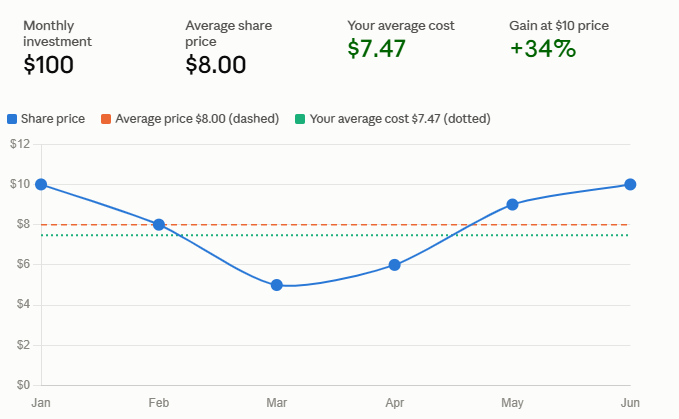
The basic idea is straightforward: your fixed contribution buys more shares when prices are low and fewer shares when prices are high. Over time, your purchase price per share depends on how much you invest and the prices at which your purchases occur.
How Dollar-Cost Averaging Works in Practice
Imagine you invest $200 every month into an S&P 500 index fund. The fund’s share price changes each month, so your $200 buys a different number of shares.
|
Month |
Fund price |
Monthly investment |
Shares purchased |
|---|---|---|---|
|
January |
$50 |
$200 |
4.00 |
|
February |
$40 |
$200 |
5.00 |
|
March |
$25 |
$200 |
8.00 |
|
April |
$40 |
$200 |
5.00 |
|
Total |
— |
$800 |
22.00 |
You invest $800 and purchase 22 shares. Your average purchase price is about $36.36 per share.
The fund’s simple average monthly price is $38.75. Because you bought more shares when the price was lower, your average purchase price is below that simple average.
This example illustrates how DCA works. It does not prove that you will earn a profit: the fund could fall further, and your investment’s value could remain below your total contributions.
Key Features of Dollar-Cost Averaging for Beginners
Dollar-cost averaging is popular because it turns investing into a repeatable routine rather than a guessing game.
-
Fixed contributions: Invest a consistent amount on a weekly, biweekly, or monthly schedule.
-
Automatic investing: Many US brokerages and retirement plans let you automate contributions.
-
Flexible starting amount: You can begin with an amount that fits your budget, subject to your account and investment requirements.dollar cost averaging meaning in urdu
-
Less market timing: You do not need to predict every short-term market move.
-
Potentially lower emotional stress: A preset plan can make it easier to continue investing during market declines.
-
Long-term focus: DCA works best as part of a broader plan that considers diversification, costs, and financial goals.
Dollar-Cost Averaging vs. Lump-Sum Investing
Lump-sum investing means investing all the available money at once. DCA can mean investing from each paycheck as you earn it, or spreading out a large amount you already have.
That difference matters. Regular paycheck contributions put newly available money to work as you receive it. Delaying investment of money already sitting in cash creates an opportunity cost.
Vanguard research found that lump-sum investing outperformed cost averaging in roughly two-thirds of the historical periods studied. That does not guarantee future results, but it challenges the idea that DCA always produces higher returns
|
Feature |
Dollar-cost averaging |
Lump-sum investing |
|---|---|---|
|
Investment timing |
Regular intervals |
All at once |
|
Starting approach |
Gradual |
Immediate |
|
Market timing required |
No |
No |
|
Short-term entry risk |
Spread across purchases |
Concentrated at the entry date |
|
Potential in rising markets |
Some money enters later |
More money participates immediately |
|
Best suited to |
Regular income and investors who value a routine |
Available cash and investors comfortable with volatility |
Pros and Cons of Dollar-Cost Averaging
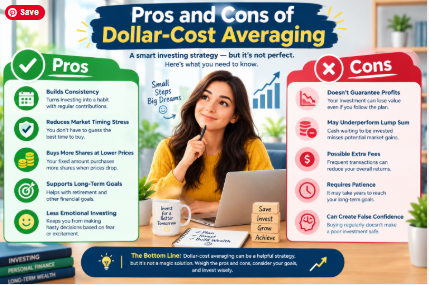
Every investing strategy involves trade-offs. Understanding them can help you decide whether DCA fits your financial situation.
Pros of Dollar-Cost Averaging
-
Builds consistency: Regular contributions help turn investing into a habit.
-
Reduces the pressure to time the market: You do not have to choose a single perfect entry point.
-
Buys more shares at lower prices: A fixed contribution purchases more shares when prices fall.
-
Supports retirement saving: Automatic contributions can make investing through a workplace 401(k) easier.
-
May reduce entry-point regret: You avoid putting all a planned investment into the market on one particular day.
Cons of Dollar-Cost Averaging
-
Does not guarantee profits: Your investment can lose value even if you follow the plan.
-
Can underperform lump-sum investing: Cash waiting to be invested misses potential market gains.
-
May involve extra fees: Frequent transaction charges can reduce returns.
-
Requires patience: The strategy may take years to support long-term financial goals.
-
Can create false confidence: Buying regularly does not make a poor investment safe.
DCA is a method of investing, not a way to eliminate market risk. FINRA explains that investors should consider the trade-off between managing short-term risk and potentially giving up returns.dollar cost averaging calculator.
Dollar-Cost Averaging Performance: Can It Beat the Market?
The performance of dollar-cost averaging depends on market conditions, investment costs, and the timing of each purchase. It can help investors continue buying during a downturn, but it cannot guarantee better results than investing a lump sum.
Historical Performance of DCA vs. Lump-Sum Investing
Vanguard’s research compared the two approaches across historical market data. Lump-sum investing outperformed cost averaging in approximately two-thirds of the periods studied. This was largely because investments generally have more time to participate in market growth when invested earlier.
|
Market situation |
How DCA may perform |
Main consideration |
|---|---|---|
|
Market rises steadily |
May lag lump-sum investing |
Some money remains uninvested |
|
Market falls after investing begins |
Later purchases buy more shares |
Earlier purchases may lose value |
|
Market moves up and down |
Spreads purchases across prices |
Results depend on the price path |
|
Market recovers after a decline |
Can benefit from buying during lower prices |
Recovery is never guaranteed |
|
Market continues falling |
Buys more shares at lower prices |
Portfolio losses can continue |
Past performance does not predict future results. These are general illustrations, not forecasts.
Real-World Example: Investing $6,000
Consider an American investor who has $6,000 available for a long-term investment. The investor is choosing between two strategies:
-
DCA approach: Invest $1,000 monthly for six months.
-
Lump-sum approach: Invest the full $6,000 immediately.
If stock prices rise throughout those six months, lump-sum investing will generally benefit because the entire amount participates from the beginning. If prices fall soon after the initial investment, DCA may benefit from buying some shares at lower prices.
Neither approach can predict what the market will do. If the $6,000 is genuinely available for long-term investing, the choice comes down to expected returns, risk tolerance, and emotional comfort. Money needed soon for rent, bills, or emergencies should not be invested simply to follow either strategy.
Dollar-Cost Averaging Pricing: What Does It Cost?
Dollar-cost averaging is not a financial product with one universal price. It is an investing method, and its cost depends on the brokerage, investment fund, account type, and number of transactions.
|
Cost category |
Typical consideration |
What to check |
|---|---|---|
|
Brokerage commissions |
Some brokers offer commission-free online stock and ETF trades |
Current trade fees and restrictions |
|
Fund expense ratio |
Ongoing annual fund operating expenses |
Expense ratio in the fund prospectus |
|
Account fees |
Some accounts charge maintenance or other service fees |
Brokerage fee schedule |
|
Automatic investing |
May be available without an extra charge |
Eligibility and supported investments |
|
Taxes |
Depends on the account and transaction |
Taxable account vs. retirement account rules |
A commission-free trade is not necessarily a cost-free investment. Fund expenses still matter, and some fees can apply even when you invest automatically.
How to Keep Dollar-Cost Averaging Costs Low
-
Compare the expense ratios of similar diversified index funds.
-
Check whether your brokerage supports automatic purchases without commissions.
-
Review account maintenance fees and minimum investment requirements.
-
Avoid unnecessary trading and frequent changes to your plan.
-
Understand the tax rules for taxable brokerage accounts, traditional IRAs, and Roth IRAs.
For official beginner guidance, visit the SEC’s Investor.gov investing resources. You can also review FINRA’s explanation of dollar-cost averaging before deciding how to invest.
How to Start Dollar-Cost Averaging in the USA
You do not need a complicated investing system to begin. A clear plan and regular contributions are more useful than constantly changing your strategy in response to market news. How to Invest in the S&P 500 From the UK: A Guide
-
Set your financial priorities. Build an emergency fund, cover essential expenses, and consider paying down high-interest debt before committing money to investments.
-
Choose an appropriate account. Depending on your goals, consider a workplace 401(k), an IRA, or a taxable brokerage account. Each has different rules and tax treatment.
-
Select a suitable investment. Research diversified, low-cost index funds or ETFs and understand what they hold. Diversification reduces dependence on individual companies but does not eliminate market risk.
-
Choose a realistic contribution. You might start with $50, $100, or another amount that fits your budget. Consistency matters more than choosing an amount you cannot sustain.
-
Automate contributions where appropriate. Schedule investments around payday to reduce the temptation to delay investing because of market headlines.
-
Review your plan periodically. Check your savings rate, fees, investment allocation, and goals. Avoid making frequent changes based on short-term market movements.
Dollar-Cost Averaging in a 401(k) or Roth IRA
Many American workers already use a form of DCA through regular 401(k) contributions deducted from their paychecks. The money is invested according to the plan’s selected investment options.
An IRA can also support a regular investing routine, depending on the provider and available investments. Roth IRA contributions are subject to eligibility and annual contribution limits, so check the current IRS rules before contributing.
For more information, see the IRS retirement plans and IRA guidance.
If you are building a broader retirement strategy, you can also link this article to your own related post about how to invest in the S&P 500. This is a suggested internal link; make sure the URL matches your published article.
FAQs About Dollar-Cost Averaging
1. What is dollar-cost averaging in simple terms?
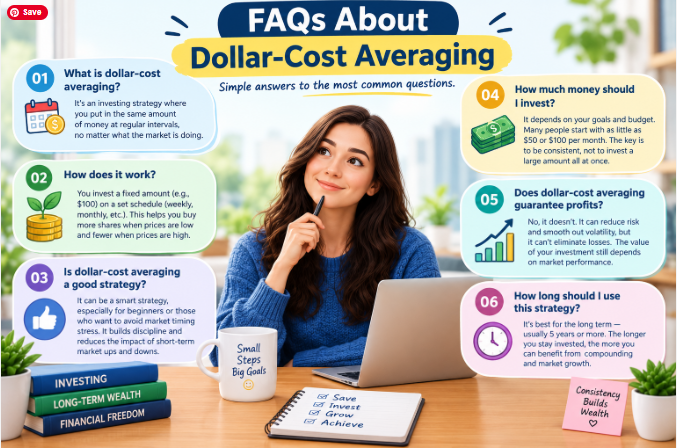
Dollar-cost averaging means investing the same amount of money at regular intervals, regardless of market prices. For example, investing $100 every month into a diversified index fund is a simple DCA strategy. It helps build consistency but does not guarantee a profit.dollar cost averaging calculator s&p 500
2. Can dollar-cost averaging beat the market?
Dollar-cost averaging can produce positive returns, but it does not automatically beat the market or outperform lump-sum investing. Historical research from Vanguard found that lump-sum investing performed better in roughly two-thirds of the periods studied. DCA may still suit investors who value a gradual approach and help manage emotional reactions to volatility.
3. How much money should I invest each month?
The right amount depends on your income, expenses, emergency savings, debt, and financial goals. Some beginners start with $50 or $100 per month. Choose an amount you can maintain without affecting essential expenses. Increase your contributions when your financial situation allows.
4. Is dollar-cost averaging good for beginners?
It can be useful for beginners because it provides a simple investing routine and reduces the pressure to predict short-term market movements. However, beginners should still learn about diversification, investment fees, risk, and the possibility of losing money before investing.
5. Is dollar-cost averaging better than investing a lump sum?
Neither method is always better in every situation. Lump-sum investing has historically outperformed gradual investing more often when the full amount was available upfront. DCA can spread out the timing of purchases and may feel more comfortable to investors worried about an immediate market decline. Your circumstances and risk tolerance matter.
Conclusion:
Dollar-cost averaging is a practical strategy for people who want to invest regularly without worrying about every market movement. It can help American investors develop good habits, buy more shares when prices are lower, and continue contributing toward long-term goals.Dollar-cost averaging calculator s&p 500
Who wins? Investors who benefit from consistency and are more comfortable entering the market gradually may find DCA useful. Investors with a lump sum already available who can tolerate market volatility may prefer investing it sooner, since historical evidence generally favors having money invested for longer.
The most important factor is not finding a strategy that promises to beat the market. It is choosing an appropriate investment, controlling fees, diversifying your portfolio, and following a realistic plan over time. Gold dollar-cost averaging calculator
Start with an amount that fits your budget, understand the risks, and focus on your long-term financial goals. Dollar-cost averaging can be a helpful part of that process, but no investing strategy guarantees success.