Some investors earn cash every quarter just for holding shares. That’s the basic idea behind dividend stocks for beginners — one of the simplest ways to start earning real income from the stock market. You buy shares in a company. The company pays you a slice of its profit. You don’t have to sell anything to see the money land in your account.
That part is simple. Choosing which companies to trust, understanding how the payments get taxed, and avoiding common beginner traps takes more explaining. This guide covers all three. For the fundamentals straight from a regulator, check the U.S. SEC’s Introduction to Investing Basics alongside this guide. Best High-Yield Savings Accounts in the USA
What Is a Dividend Stock? A Quick Definition for Beginners
A dividend stock is a share in a company that pays part of its profit to shareholders on a regular schedule. In the US, companies usually pay quarterly. In the UK, they often pay quarterly or twice a year.
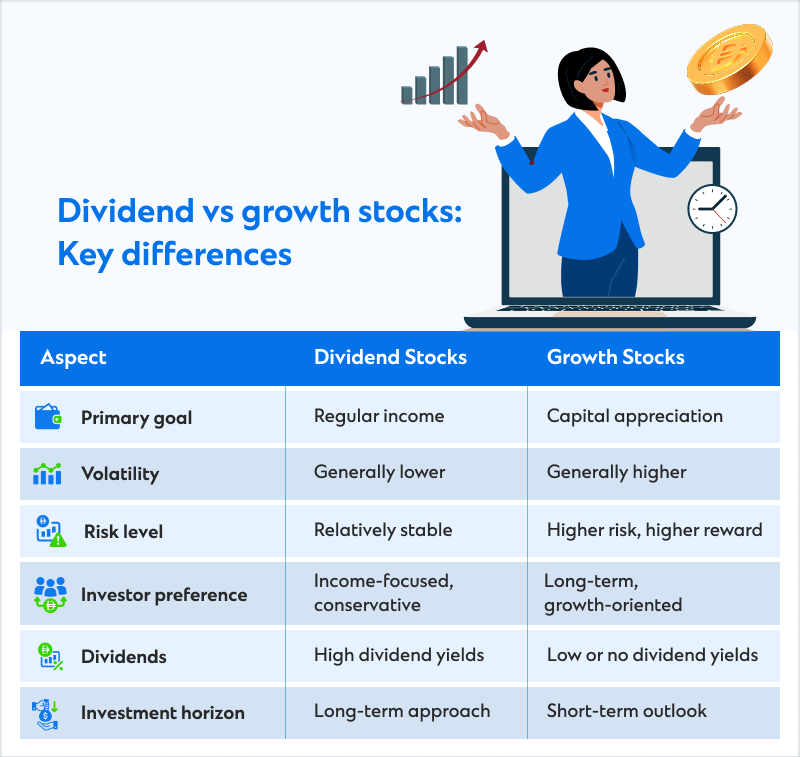
Not every company does this. Young, fast-growing companies — think early-stage tech firms — usually reinvest every dollar back into the business instead. Mature, cash-generating companies — consumer staples, utilities, banks, energy firms — share profits more readily because they don’t need every dollar for growth.
Owning a dividend stock gives you two potential sources of return:
- Price appreciation — the stock itself may rise in value over time.
- Dividend income — cash paid per share, regardless of what the stock price does that quarter.
For beginners, the income part stands out. You can actually see this return land in your account. You don’t have to sell to realize it.
Key Dividend Stock Terms Every Beginner Should Know
Dividend yield is the annual dividend divided by the current share price. A $100 stock paying $4 a year yields 4%. Yield moves with the stock price. If the price drops and the payout stays the same, the yield rises — which is why an unusually high yield often signals risk, not a bargain.
Payout ratio measures the percentage of earnings a company pays out as dividends. A payout ratio above roughly 75–80% (REITs work differently) leaves little room for error if earnings dip.
Ex-dividend date marks the cutoff for owning the stock in order to receive the next payment. Buy on or after this date, and you’ll miss that payout.
Dividend Aristocrats are S&P 500 companies that have raised their dividend every year for at least 25 consecutive years. Beginners researching dividend stocks often start here. As of 2026, 69 companies hold this status, spanning sectors from consumer staples to industrials — you can view the full, regularly updated 2026 Dividend Aristocrats list here. These companies cluster in essential-demand sectors — industrials, consumer staples, financials — where steady cash flow funds a rising payout. The group’s median yield sits at just 2.5%, so the reward shows up as lower volatility rather than a high headline yield.
Dividend Reinvestment Plan (DRIP) automatically uses your cash dividend to buy more shares of the same stock instead of depositing cash. Over long periods, reinvested dividends compound and can meaningfully boost total returns. Most brokers now offer this as a free, one-click setting. How to Start Investing with $500: Beginner’s Guide
Why Dividend Stocks Appeal to Beginners
- Cash flow you can track. A dividend payment gives you a concrete number, easier to follow than share price swings alone.
- A quality filter, not a guarantee. Companies need real free cash flow to pay a dividend — not just a good growth story.
- Lower (but not zero) volatility historically. Dividend-focused indexes have often fallen less than the broader market during downturns. That’s a historical tendency, not a promise.
- Flexibility. You can take the cash as income or reinvest it, and you can change that choice as your goals change.
This combination explains why dividend stocks for beginners come up so often as a recommended entry point into investing. Still, the downsides deserve equal attention.
Pros and Cons of Dividend Stocks for Beginners
Pros
- Regular, trackable income
- Often lower volatility than high-growth stocks
- Rewards patience and compounding
- Wide range of entry points (individual stocks, ETFs, index funds)
Cons
- Companies can cut or suspend dividends in a downturn — nothing is guaranteed
- A high yield can signal financial trouble, not opportunity
- Dividend income is taxable in most accounts (more on this below)
- Concentrating in dividend stocks alone can reduce exposure to high-growth sectors like tech
How the US Taxes Dividend Stocks
IRS Publication 550, Investment Income and Expenses sets out the official rules. Dividends fall into two categories.
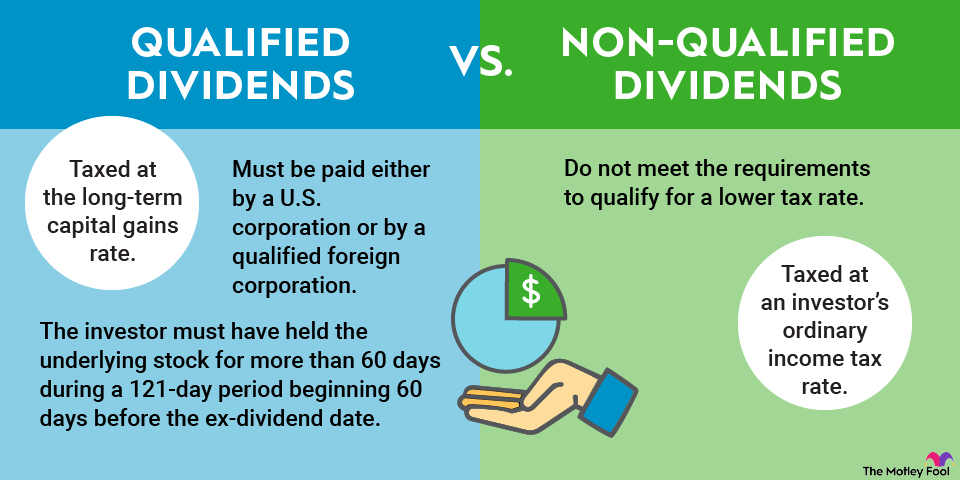
Qualified dividends get preferential tax treatment. Most dividends from US common stocks held for the required period fall into this bucket. For 2026, single filers pay 0% on qualified dividends up to $49,450 of taxable income, 15% between $49,451 and $545,500, and 20% above that. Married couples filing jointly pay 0% up to $98,900, 15% up to $613,700, and 20% above it.
Non-qualified (“ordinary”) dividends get taxed at your regular income tax rate instead — up to 37%. REITs, money-market funds, and shares held too briefly usually fall into this category. High earners may also owe the 3.8% Net Investment Income Tax on top of these rates. None of this applies inside a tax-advantaged account like a 401(k) or IRA, where dividends grow tax-deferred or tax-free.
How the UK Taxes Dividend Stocks
GOV.UK’s Tax on Dividends page lays out the official rules for UK investors. Every taxpayer gets a dividend allowance before any tax is owed. For the 2026/27 tax year, that allowance is £500 — the first £500 of dividend income stays tax-free regardless of your income tax band.
Above that threshold, your tax band decides the rate. Basic rate taxpayers pay 10.75%. Higher rate taxpayers pay 35.75%. Additional rate taxpayers pay 39.35%. These rates rose by two percentage points from April 2026.
Dividends held inside a Stocks and Shares ISA stay exempt entirely, no matter how large the balance. That’s why most UK beginners open an ISA before a general investment account.
Tax rules change; the figures above are current as of September 2026. Confirm details with the IRS, HMRC, or a qualified tax adviser before you act on your own situation.
How to Start Investing in Dividend Stocks as a Beginner
- Pick an account. US investors typically use a brokerage account, Roth IRA, or traditional IRA. UK investors usually start with a Stocks and Shares ISA for tax-free growth. The SEC’s Investing Basics section explains how US account types and stock markets work if you’re starting from zero.
- Decide: individual stocks, ETFs, or both. Individual dividend stocks require you to research and monitor each company yourself. A dividend-focused ETF — one tracking the Dividend Aristocrats index, for example — instantly diversifies you across dozens of companies for a small annual fee. Many beginners start here.
- Check the fundamentals before buying. Look past the yield. Review the payout ratio, the years of consecutive increases, and the free cash flow trend.
- Decide on reinvestment. Turn on DRIP if you’re investing long-term and don’t need the income now. Take the cash if you plan to spend it or move it elsewhere.
- Diversify across sectors. Concentrating in one sector — utilities, for example — means a downturn there hits your entire dividend income at once.
- Review annually, not daily. Daily portfolio checks tend to trigger reactive decisions that hurt long-term returns. Dividend investing rewards patience instead.
Best Dividend Stocks for Beginners: Individual Stocks vs. ETFs
Beginners often ask whether to buy individual dividend stocks or a diversified dividend ETF. Here’s how the two compare:
| Factor | Individual Dividend Stocks | Dividend ETFs (e.g., Aristocrats funds) |
|---|---|---|
| Diversification | Low unless you buy many stocks | High — instantly spread across dozens of companies |
| Research required | High — you track each company’s financial health | Low — the fund’s index rules do the selecting |
| Control | Full control over which companies you own | Limited — you own whatever the fund holds |
| Fees | No ongoing fund fee, but trading costs on each stock | Small annual expense ratio (often well under 0.5%) |
| Risk of a single dividend cut | Hits your income directly | Spreads across the whole fund |
| Best for | Beginners willing to research and monitor holdings | Beginners who want simplicity and instant diversification |
A Simple Example
Say you invest $10,000 in a dividend ETF yielding 3% a year, and you reinvest every payment. In year one, you’d earn roughly $300 in dividends. That $300 buys more shares, and those new shares generate their own dividends the following year. This is compounding in action.
Over 20–30 years, especially with regular additional contributions, this reinvestment effect builds real momentum. It’s why long-term dividend investors focus on consistency rather than chasing today’s highest available yield.
Common Mistakes Beginners Make With Dividend Stocks
- Chasing the highest yield. A stock yielding 9–10% against peers at 2–3% usually prices in the real risk of a dividend cut. It’s rarely a free lunch.
- Ignoring the payout ratio. A company that pays out more than it earns borrows from its own future to fund today’s dividend.
- Skipping research because a stock “feels safe.” A safe reputation doesn’t replace checking the numbers yourself.
- Forgetting taxes. Dividend income triggers a tax event the year you receive it, even if you reinvest automatically. Check the IRS or GOV.UK guidance above for current rules.
- Putting everything into one sector. Rate-sensitive sectors like utilities and REITs can move together; spreading across sectors reduces that risk.
FAQs About Dividend Stocks for Beginners
Is dividend investing good for beginners?
Yes, for many it’s a solid starting point. It teaches core investing concepts — yield, payout ratio, diversification — through a return you can actually track. It shouldn’t be your only strategy, though. Most portfolios benefit from a mix of growth and dividend-paying assets.
How much money do I need to start investing in dividend stocks?
Many brokers now allow fractional shares, so you can start with $5–$50 in the US, or a similarly small amount in the UK. Consistency over time matters more than your starting amount.
What’s a “good” dividend yield for beginners to look for?
There’s no universal number, but yields between 2% and 5% from financially healthy, established companies are generally sustainable. Anything well above that deserves extra scrutiny of the payout ratio and cash flow.
Are dividend stocks safer than growth stocks?
As a group, they’ve historically shown lower volatility. But “safer” doesn’t mean risk-free — individual dividend-paying companies can still lose significant value or cut their payouts.
Should I reinvest my dividends or take the cash?
Reinvest (DRIP) if you don’t need the income yet, and you’re investing long-term; the payouts buy more shares and compound over time. Take the cash if you need current income, such as in retirement.
What are Dividend Aristocrats, and should beginners only buy those?
They’re S&P 500 companies with 25+ consecutive years of dividend increases — a useful shortlist of proven payers (see the current 2026 list). But they’re not your only option. Newer or non-S&P 500 companies can also pay strong, reliable dividends; treat the Aristocrats list as a starting filter, not a complete strategy.
Conclusion:
Dividend stocks for beginners offer a visible, recurring return simply by holding shares in financially healthy companies. But “dividend” doesn’t automatically mean “safe.”
Start by opening the right account — a brokerage or IRA in the US, an ISA in the UK. Decide whether individual stocks or a diversified ETF fits your appetite for research. Check the payout ratio and dividend history before you buy anything based on yield alone. From there, consistency matters more than picking the single “best” stock on day one — reinvest where it makes sense, and review your holdings annually rather than daily.