Trying to invest at the perfect moment can feel like an impossible task. Prices rise, markets fall, and even experienced dollar-cost averaging investors struggle to predict what will happen next. Waiting for the right time can leave your money sitting on the sidelines instead of working toward your financial goals.
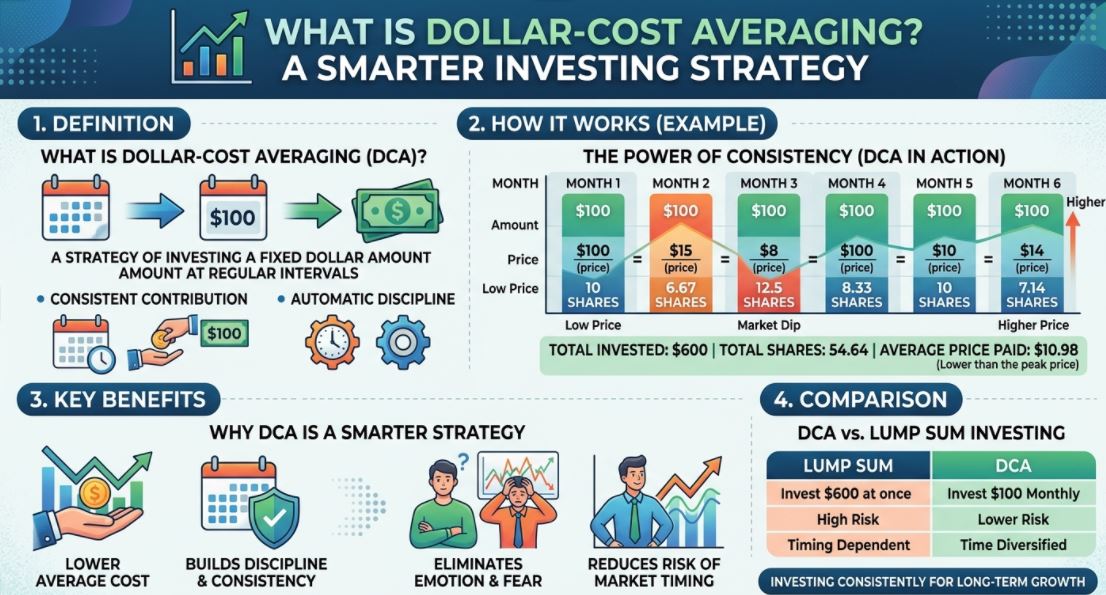
Dollar-cost averaging (DCA) offers a simpler approach: invest a fixed amount of money at regular intervals, regardless of market conditions. When prices are lower, your money buys more shares or fund units. When prices are higher, it buys fewer.
This approach can help investors build a consistent habit, reduce the pressure of market timing, and stay focused on long-term goals. However, it does not guarantee profits or automatically beat the market.
In this guide, you will learn how dollar-cost averaging works, see a practical example, compare it with investing a lump sum, and discover how investors in the United States and the United Kingdom can apply the strategy. How to Invest in the S&P 500 from the UK (2026)
What Is Dollar-Cost Averaging?
Dollar-cost averaging is an investment strategy in which you invest a predetermined amount at regular intervals, such as every week, every two weeks, or every month.
Instead of investing all your available money at once, you spread your purchases over time.
For example, imagine you decide to invest $200 every month in a diversified index fund. You continue investing that amount whether the fund’s price rises or falls, provided the investment remains appropriate for your goals.
The result is that you automatically purchase more units when prices are low and fewer units when prices are high.
In the UK, the same principle is often called pound-cost averaging because investments are made in pounds rather than dollars. The underlying strategy is the same.
Dollar-cost averaging is particularly relevant to people who invest part of their salary regularly. It can also be used by investors who have a larger amount of cash but prefer to phase their investments into the market.
How Does Dollar-Cost Averaging Work?

The process is straightforward:
-
Choose an investment amount. Decide how much you can afford to invest without affecting essential expenses or emergency savings.
-
Select an investment. This might be a diversified index fund, an exchange-traded fund (ETF), or another investment suitable for your circumstances.
-
Set a schedule. Choose a regular interval, such as your monthly payday.
-
Invest consistently. Invest the planned amount regardless of short-term price movements.
-
Review your plan periodically. Check your investment costs, diversification, risk level, and progress toward your goals.
Many investment platforms offer recurring investment features, although availability, fees, minimum amounts, and eligible investments vary.
The key is consistency, not predicting whether next month’s market will be higher or lower.
A Simple Dollar-Cost Averaging Example
Suppose you invest $300 every month in an investment fund. For simplicity, assume there are no fees, taxes, or distributions and that each month’s purchase happens at the stated price.
| Month | Amount invested | Price per unit | Units purchased |
|---|---|---|---|
| January | $300 | $30 | 10 |
| February | $300 | $25 | 12 |
| March | $300 | $20 | 15 |
| April | $300 | $24 | 12.5 |
| May | $300 | $30 | 10 |
| Total | $1,500 | — | 59.5 |
You invest $1,500 and acquire 59.5 units.
Your average purchase price is approximately $25.21 per unit, calculated by dividing the total amount invested by the total units purchased.
The simple average of the five monthly prices is $25.80. Your average purchase price is lower because the fixed contributions purchased more units during the lower-price months.
This illustrates the mechanics of dollar-cost averaging. It does not mean the investment has made a profit: the current market value of the units still determines whether you have a gain or loss.
Does Dollar-Cost Averaging Actually Beat the Market?
Despite the appeal of the strategy, dollar-cost averaging does not automatically outperform the stock market.
Its main advantage is that it gives investors a repeatable process for investing without needing to predict short-term price movements. The actual result depends on market performance, the investment chosen, fees, taxes, and how long the investor stays invested.
FINRA explains that when someone already has a lump sum available, investing it gradually can result in lower returns than investing it all at once, particularly when markets rise during the investment period.
Consider two investors:
-
Investor A has $12,000 available and invests it immediately in a suitable long-term portfolio.
-
Investor B has the same $12,000 but invests $1,000 per month over 12 months, keeping the uninvested balance in cash.
If the market rises steadily, Investor A benefits from having more money invested earlier. If the market falls shortly after Investor A invests, Investor B may avoid some of the initial decline because part of the money has not yet been invested.
Neither outcome is guaranteed. Markets can rise, fall, or move sideways during the same period.
There is also an important distinction: if you invest $1,000 from your salary every month as you earn it, you are not delaying investment of an existing $12,000 lump sum. You are investing new money as it becomes available. In that situation, regular investing is a practical way to build a portfolio.
The bottom line: Dollar-cost averaging is a strategy for managing your investment process, not a reliable method for beating a market index.
Dollar-Cost Averaging vs. Lump-Sum Investing

Both approaches can be reasonable, but they solve slightly different problems.
| Feature | Dollar-cost averaging | Lump-sum investing |
|---|---|---|
| Investment timing | Spreads purchases over time | Invests available money immediately |
| Cash required | Smaller amounts at each interval | Full investment amount upfront |
| Emotional pressure | May make investing easier to maintain | Requires comfort with immediate market exposure |
| Rising market | May miss some early gains | Benefits from earlier exposure |
| Falling market | Later purchases may buy at lower prices | Entire investment is exposed to the initial decline |
| Transaction costs | May involve more transactions | May involve fewer transactions |
| Typical use case | Regular income and gradual investing | An existing lump sum intended for investment |
No strategy eliminates market risk. The appropriate choice depends on whether the money is already available, your financial goals, and how comfortable you are with market fluctuations.
Benefits of Dollar-Cost Averaging
Dollar-cost averaging offers several practical advantages.
1. It Reduces the Pressure to Time the Market
Trying to identify the lowest market price is difficult. Investors may wait for a decline that never arrives or invest impulsively after prices have already risen.
A regular schedule removes the need to make a fresh timing decision for every purchase.
2. It Builds a Consistent Investing Habit
A fixed monthly contribution can make investing part of your normal financial routine. For example, you might arrange an investment after payday, just as you schedule savings or bill payments.
This can be especially helpful for beginners who are learning to manage their money over a long period.
3. It Buys More Units When Prices Fall
Because your contribution remains fixed, a lower price means you can purchase more units. Those additional units may benefit if prices later recover, although recovery is not guaranteed.
4. It Can Make Volatile Markets Easier to Navigate
Seeing a portfolio fall can be uncomfortable. Regular purchases provide a structured way to continue investing through volatility, assuming the investment still suits your objectives and financial circumstances.
5. It Works With Regular Income
Employees, freelancers, and other earners can invest money as they receive it instead of waiting to accumulate a large amount before starting.
Disadvantages and Risks of Dollar-Cost Averaging
Dollar-cost averaging has limitations that investors should understand before using it.
1. It Does Not Prevent Losses
If you regularly buy a fund that continues to decline, your investment can lose substantial value. Purchasing additional units at lower prices does not make an unsuitable investment safe.
2. It May Underperform Lump-Sum Investing
When an investor already has cash available, delaying investment can mean missing market gains. In rising markets, investing earlier often gives the money more time exposed to potential returns.
3. Fees Can Reduce Returns
Some platforms charge dealing fees or other transaction costs. Making many small purchases can be more expensive than making fewer larger purchases, depending on the platform’s pricing structure.
Always compare dealing charges, fund expense ratios, foreign-exchange costs, and other applicable fees before setting up recurring investments.
4. It Requires Discipline
A strategy only works as planned if you follow it. Investors who stop buying whenever markets decline may miss the intended benefit of maintaining a consistent schedule.
5. It Does Not Guarantee Diversification
Investing regularly in one company or a narrow sector does not spread your investment risk across different assets. The investment itself still needs to be assessed for concentration, suitability, and potential losses.
The SEC’s Investor.gov guidance explains that index funds have their own risks, fees, and tracking differences. A fund’s label alone does not guarantee a particular return or level of diversification.
How to Start Dollar-Cost Averaging in the USA
If you live in the United States, you can use the following steps to build a regular investing plan.
Step 1: Organize Your Finances
Before investing, make sure you can cover essential expenses, manage high-interest debt, and maintain appropriate emergency savings. Avoid committing money that you may need for near-term bills.
Step 2: Choose an Investment Account
Depending on your eligibility and goals, you might consider a taxable brokerage account or a retirement account such as a 401(k) or IRA. Each account has its own rules, contribution limits, tax treatment, and withdrawal conditions.
For current account rules, consult the IRS and your plan provider rather than relying on outdated limits.
Step 3: Select an Appropriate Investment
Some investors use diversified index mutual funds or ETFs to obtain exposure to a broad market. Others choose a portfolio containing several asset classes based on their goals and risk tolerance.
An index fund seeks to track a particular market index; it does not guarantee that you will earn the index’s return after costs.
Step 4: Decide How Much to Invest
Choose a contribution you can sustain. For example, investing $150 every month means contributing $1,800 over 12 months, before any investment gains, losses, fees, or taxes.
The amount should fit your budget rather than force you to borrow or neglect important expenses.
Step 5: Automate Your Contributions
If your account supports recurring purchases, set up a schedule that matches your income. Check that the instructions are correct and that sufficient cash is available when each purchase is due.
Step 6: Review Your Plan
Check your investments periodically, including fees, asset allocation, and whether your goals have changed. Avoid making unnecessary changes based solely on daily market headlines.
How to Use Dollar-Cost Averaging in the UK
UK investors can apply the same principle using pounds. It is often called pound-cost averaging, but the mechanics are identical.
Consider a Stocks and Shares ISA
An eligible UK investor may use a Stocks and Shares ISA to hold qualifying investments under the ISA rules. ISA tax treatment and eligibility depend on current legislation and individual circumstances.
Check the latest guidance from GOV.UK before deciding which account to use. Do not assume that all investments or overseas accounts receive the same tax treatment.
Compare Funds and Platforms
When comparing investment platforms, check:
-
Platform and account charges.
-
Fund management fees.
-
Dealing fees and recurring-purchase charges.
-
Foreign-exchange fees if buying overseas assets.
-
Available funds and minimum investment amounts.
-
Whether automatic monthly investing is supported.
Understand Currency Risk
Buying a US-focused investment from a UK account can involve exposure to US markets and potentially to movements between the pound and the dollar. A fund’s trading currency is not necessarily the same as the currency risk of its underlying investments.
Currency movements can increase or reduce your returns when measured in pounds.
Keep the Strategy Suitable for Your Goals
Money needed for a house deposit or another near-term expense may not be appropriate for stock-market investing. Regular contributions do not protect you from a market decline just before you need to withdraw the money.
For UK-specific tax questions, account eligibility, and current ISA rules, consult official HMRC and GOV.UK guidance.
Common Dollar-Cost Averaging Mistakes to Avoid
Even a straightforward strategy can go wrong when investors misunderstand its purpose.
-
Expecting guaranteed profits: Prices can keep falling, and investments can lose value.
-
Ignoring fees: Small recurring charges can add up.
-
Buying without research: A fixed schedule does not make every investment worth owning.
-
Investing money needed soon: Stocks and stock funds may be unsuitable for short-term financial goals.
-
Stopping during every downturn: Frequent changes can undermine a long-term plan.
-
Confusing consistency with diversification: Regularly buying the same concentrated investment does not eliminate concentration risk.
-
Holding too much cash while waiting to invest a lump sum: Gradual investing can create an opportunity cost if markets rise.
The objective is not to make investing risk-free. It is to establish a repeatable process that makes sense for your finances and helps you manage decisions over time.
Dollar-Cost Averaging: Comparison and Cost Table
The following table summarizes the main practical differences. Actual costs depend on the investment platform, fund, account type, and jurisdiction.
| Factor | What to consider |
|---|---|
| Minimum investment | Check the platform’s minimum recurring contribution |
| Fund expense ratio | Annual fund expenses can reduce returns |
| Dealing fees | Repeated purchases may create additional costs |
| Currency conversion | Relevant when buying investments in another currency |
| Taxes | Depend on your country, account type, and circumstances |
| Cash held before investment | May earn interest, but can miss market gains |
There is no universal fee for dollar-cost averaging itself. It is an investment approach rather than a financial product. Check the current fee schedule for your chosen platform and fund before investing.
FAQs About Dollar-Cost Averaging
1. What is dollar-cost averaging in simple terms?
Dollar-cost averaging means investing the same amount of money at regular intervals, regardless of market prices. You buy more units when prices are low and fewer when prices are high. It can simplify investing but does not guarantee profits.
2. Does dollar-cost averaging beat the market?
No, not reliably. Dollar-cost averaging can help investors maintain discipline and manage the timing of purchases, but it does not guarantee higher returns than a market index. When cash is already available, investing it immediately can outperform gradual investing if markets rise during the investment period.
3. How much money should I invest each month?
There is no single amount that works for everyone. Start with an amount that fits your income, expenses, emergency savings, debts, and long-term goals. For example, $100 per month equals $1,200 in contributions over a year, excluding investment gains, losses, fees, and taxes.
4. Is dollar-cost averaging good for beginners?
It can be useful for beginners because it provides a simple, repeatable investment routine and reduces the need to predict market movements. However, beginners still need to understand investment risk, diversification, fees, and the possibility of losing money.
5. Is dollar-cost averaging better than lump-sum investing?
Neither is always better. Gradual investing spreads purchases over time and may reduce the regret associated with investing immediately before a decline. Lump-sum investing gives available money earlier exposure to potential market gains. Your circumstances, risk tolerance, and market performance all matter.
6. Can I use dollar-cost averaging to invest in an S&P 500 fund?
Yes. An investor can arrange regular purchases of an eligible fund that tracks the S&P 500, subject to the platform’s terms and investment eligibility. The S&P 500 provides exposure to large US companies, but it is not the entire global stock market and can experience substantial declines.
7. How often should I invest using dollar-cost averaging?
Monthly investing is a common option, especially for people who invest from their salaries. Weekly or biweekly investing can also work. The most suitable schedule depends on when you receive income, available platform features, and transaction costs.
8. Is dollar-cost averaging tax-efficient in the USA and UK?
Dollar-cost averaging does not automatically provide tax advantages. Tax treatment depends on the account, investments, and applicable laws. US investors should review IRS guidance on brokerage and retirement accounts, while UK investors should check HMRC guidance on ISAs and taxable investments.
Conclusion: Build a Consistent Investing Plan
Dollar-cost averaging offers a practical way to invest regularly without trying to predict every market move. By committing a manageable amount at consistent intervals, investors can build a portfolio over time and reduce the pressure of deciding when to buy.
But remember that consistency is not the same as guaranteed performance. Your investment choices, fees, diversification, time horizon, and ability to tolerate losses remain essential.
If you are ready to get started, review your budget, choose an investment appropriate for your goals, compare available accounts and fees, and establish a sustainable contribution schedule. If you already have a substantial amount of cash available, compare the potential benefits and drawbacks of investing it immediately versus gradually.