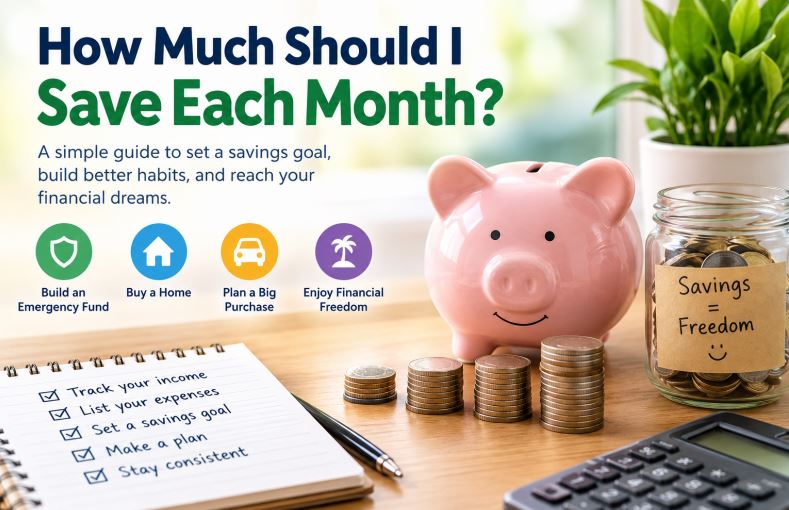
How much should I save each month? Saving money is easy to talk about, but putting money aside at the end of the month is a different story. One unexpected bill, a grocery trip, or a car repair can quickly eat into your paycheck. Before you know it, another month has passed, and your savings account still looks the same.
The truth is that building savings is not about earning more money or giving up everything you enjoy. It is about knowing how much you can comfortably save and making that money work toward your future. Whether you want to prepare for emergencies, buy a house, pay for a big purchase, or enjoy greater financial freedom, a realistic monthly savings plan can help you get there.
So, how much money should you actually save each month? The answer depends on your income, expenses, and financial goals. Let’s break down the numbers, explore simple budgeting rules, and find a monthly savings target that works for your life.
What Is a Monthly Savings Goal?
A monthly savings goal is the amount of money you plan to set aside every month. You can use this money for emergencies, a home down payment, a car, a vacation, retirement, or other important plans.
Your savings goal should fit your current financial situation. Someone earning $3,000 per month may need a different plan from someone earning $7,000 per month.
The 50/30/20 Budgeting Rule
The 50/30/20 rule is a simple way to organize your take-home income:
- 50% for needs: Housing, groceries, utilities, insurance, transportation, and minimum debt payments.
- 30% for wants: Restaurants, entertainment, shopping, subscriptions, and hobbies.
- 20% for savings and extra debt payments: Emergency savings, financial goals, retirement contributions, and additional debt repayment.
For example, a person taking home $4,000 per month could plan to spend $2,000 on needs, $1,200 on wants, and $800 on savings and extra debt payments.
These percentages are guidelines, not strict rules. High housing costs or childcare expenses may make the 50% needs target unrealistic. Adjust the percentages to match your life.
How Much Should I Save Each Month?

A useful savings target is a percentage of your monthly take-home pay. Take-home pay is the money you receive after taxes and payroll deductions.
| Monthly take-home pay | 10% savings | 20% savings | 30% savings |
|---|---|---|---|
| $2,000 | $200 | $400 | $600 |
| $3,000 | $300 | $600 | $900 |
| $4,000 | $400 | $800 | $1,200 |
| $5,000 | $500 | $1,000 | $1,500 |
| $6,000 | $600 | $1,200 | $1,800 |
| $8,000 | $800 | $1,600 | $2,400 |
These figures show possible savings targets, not amounts everyone can afford. Start with a realistic number based on your bills and responsibilities.
The Formula That Makes Monthly Saving Easier
Use this simple formula:
Monthly savings = Take-home income × Savings percentage
Example:
- Monthly take-home income: $3,500
- Chosen savings rate: 15%
- Monthly savings: $3,500 × 0.15 = $525
Saving $525 each month adds up to $6,300 over 12 months, before interest.
You can also calculate savings from your remaining money:
Monthly savings = Income − Essential expenses − Planned spending
If you earn $3,500 and spend $2,900 on bills and planned purchases, you have $600 remaining. You could save $500 and keep $100 available for unexpected costs.
Monthly Savings Goals for Different Financial Situations
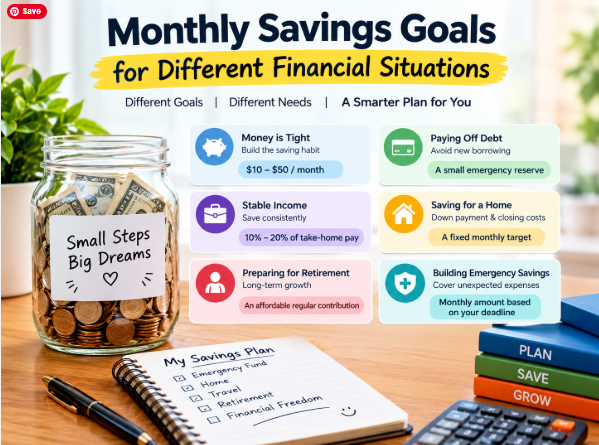
Your ideal savings amount depends on what you need the money to do. A person building an emergency fund may need a different plan from someone preparing for retirement.
| Financial situation | Suggested starting goal | Main priority |
|---|---|---|
| Money is tight | $10–$50 per month | Build the saving habit |
| Paying off expensive debt | A small emergency reserve | Avoid new borrowing |
| Stable income | 10%–20% of take-home pay | Build savings consistently |
| Saving for a home | A fixed monthly target | Down payment and closing costs |
| Preparing for retirement | An affordable regular contribution | Long-term growth |
| Building emergency savings | Monthly amount based on your deadline | Cover unexpected expenses |
These are flexible starting points rather than universal financial rules. Review your plan whenever your income, expenses, or goals change.
Pros and Cons of Saving a Percentage of Your Income
Pros
- Easy to calculate: A percentage gives you a clear monthly target.
- Flexible: Your savings amount can rise when your income increases.
- Supports financial goals: Regular deposits help you prepare for future expenses.
- Builds discipline: Automatic transfers make saving part of your routine.
- Reduces financial stress: Cash reserves can help you cope with unexpected bills.
Cons
- High living costs can make saving difficult: Rent, childcare, and healthcare may consume much of your income.
- A fixed percentage may not fit every month: Irregular income can make planning harder.
- Debt interest can slow progress: Expensive credit card debt may cost more than savings earn.
- Saving too aggressively can backfire: You may need to withdraw money or borrow again when essential expenses arise.
The goal is a savings plan you can maintain, not a percentage that makes daily life unaffordable.
How Your Savings Can Grow Over Time
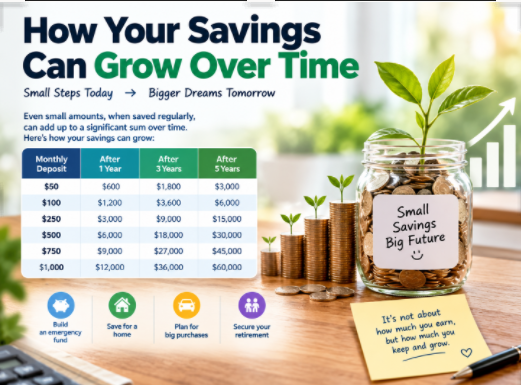
Small monthly deposits can become a useful financial cushion. The following table shows how much you would contribute at different monthly savings amounts, without counting interest or investment returns.
| Monthly deposit | After 1 year | After 3 years | After 5 years |
|---|---|---|---|
| $50 | $600 | $1,800 | $3,000 |
| $100 | $1,200 | $3,600 | $6,000 |
| $250 | $3,000 | $9,000 | $15,000 |
| $500 | $6,000 | $18,000 | $30,000 |
| $750 | $9,000 | $27,000 | $45,000 |
| $1,000 | $12,000 | $36,000 | $60,000 |
These totals assume you make every deposit and do not withdraw money. Interest may increase the balance in a savings account. Investment returns can vary, and investments may lose value.
Real-World Example: Saving on a $3,000 Paycheck
Imagine that Maria takes home $3,000 each month. Her rent, groceries, transportation, utilities, insurance, and other essential bills total $2,250. She spends another $450 on eating out, shopping, and entertainment.
Maria has $300 left each month. She decides to transfer $200 to savings after payday and keep $100 available for unexpected expenses.
Her savings deposits would reach $2,400 after one year if she makes every transfer and does not withdraw the money. She can increase the deposit when she pays off a debt or receives a raise.
Maria does not need to reach a 20% savings rate immediately. Her first priority is creating a routine she can maintain.
Where Should You Put Your Monthly Savings?
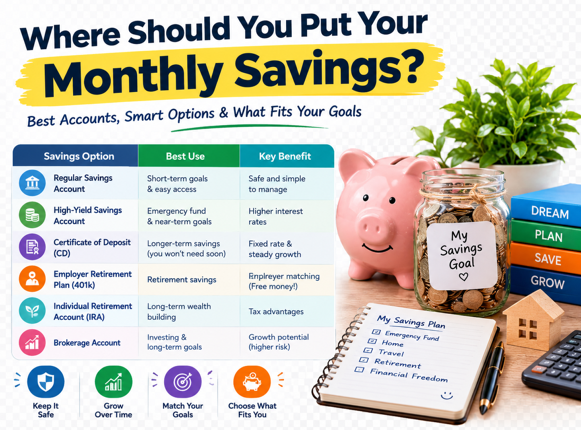
The right account depends on when you need the money and what you want to achieve.
| Savings option | Best use | Main consideration |
|---|---|---|
| Regular savings account | Short-term goals | Check fees and interest rates |
| High-yield savings account | Emergency funds and near-term goals | Rates can change |
| Certificate of deposit (CD) | Money you can leave untouched for a set term | Early withdrawals may involve penalties |
| Employer-sponsored retirement plan | Long-term retirement savings | Review fees, investment choices, and employer matching |
| Individual retirement account (IRA) | Retirement planning | Contribution and withdrawal rules apply |
| Brokerage account | Long-term investing goals | Investments can lose value |
For emergency savings, an accessible bank savings account is often a practical choice. Eligible deposits at FDIC-insured banks are protected within applicable limits. Investment accounts are not FDIC-insured against market losses.
Learn more from the FDIC’s deposit insurance resources and Investor.gov’s saving and investing information.
How to Save Money Every Month on a Realistic Budget
You do not need to cut every enjoyable expense to improve your finances. Small changes can free up money for savings.
1. Pay Yourself First
Set an automatic transfer for payday. Even $25 per paycheck can help you develop a habit. Increase the amount when your budget allows.
2. Review Your Monthly Bills
Check your phone plan, insurance, subscriptions, and internet bill. Cancel services you rarely use and compare alternatives before renewing expensive contracts.
3. Plan Your Grocery Spending
Create a shopping list, compare unit prices, plan meals, and use store rewards when they genuinely reduce costs. Avoid buying unnecessary items just to receive a discount.
4. Set a Clear Savings Goal
A goal such as saving $1,000 for unexpected expenses is easier to track than a vague plan to save more money. Give your goal a deadline and calculate the monthly deposit you need.
5. Use Separate Savings Accounts
You may find it helpful to keep emergency savings separate from vacation money or a home deposit. Clear labels can reduce the temptation to spend money meant for another goal.
6. Increase Savings Gradually
Start with an amount you can afford. Add $10 or $25 per month when your finances improve. You can also direct part of a tax refund, bonus, or pay raise toward your savings.
For more budgeting help, explore our related guide on how to save money on groceries and our guide to dollar-cost averaging. Replace these placeholders with the published URLs on your website.
How Much Should I Save Each Month for Emergencies?
An emergency fund helps cover necessary costs when something unexpected happens, such as a medical bill, urgent car repair, or loss of income.
A common long-term target is three to six months of essential living expenses. You do not need to save the full amount immediately.
If your essential expenses are $2,500 per month:
- One month of expenses equals $2,500.
- Three months equal $7,500.
- Six months equal $15,000.
Start with a smaller milestone, such as $500 or $1,000, if that is more realistic. Build your fund gradually and keep it somewhere accessible.
If your income is irregular, you support dependents, or your job is uncertain, a larger emergency fund may be useful. Let your personal circumstances guide your target.
FAQs:
1. Is Saving $500 a Month Good?
Yes, saving $500 per month can be an excellent goal if you can afford it. You would contribute $6,000 in one year before interest. Whether it is enough depends on your income, emergency fund, debt, and financial goals.
2. Is Saving 20% of My Income Enough?
Saving 20% of take-home pay is a useful guideline, but it is not right for everyone. Your target may need to be lower during expensive periods or higher if you are saving for a major goal. Consistency matters more than following a percentage that does not fit your budget.
3. How Much Should I Have in Savings at Age 30?
There is no single savings amount that every 30-year-old should have. Your income, living costs, debt, family responsibilities, and retirement progress all matter. Focus on an emergency fund, manageable debt, and regular retirement contributions instead of comparing yourself with others.
4. Should I Save Money or Pay Off Debt First?
Keep some money available for unexpected essential expenses while reviewing your debts. High-interest credit card debt often deserves priority because interest can grow quickly. Continue making required minimum payments, check any employer retirement match, and choose a balanced plan based on interest rates and your financial needs.
5. Where Should I Keep My Monthly Savings?
An accessible savings account can work well for emergency funds and goals you expect to reach soon. Compare account fees, withdrawal access, and interest rates. Money intended for retirement many years away may suit an appropriate investment account, depending on your risk tolerance and time horizon.
Conclusion
The best monthly savings amount is one that supports your future without making your present financial life unmanageable. Saving 20% of take-home pay is a helpful starting target for people whose budgets allow it. Saving 10%, 5%, or even a small fixed amount can be a sensible first step when money is tight.
Calculate your take-home income, review essential expenses, choose one realistic goal, and automate a deposit after payday. Build emergency savings before taking unnecessary risks with money you may need soon. Review your progress every month and increase your contribution when your circumstances improve.