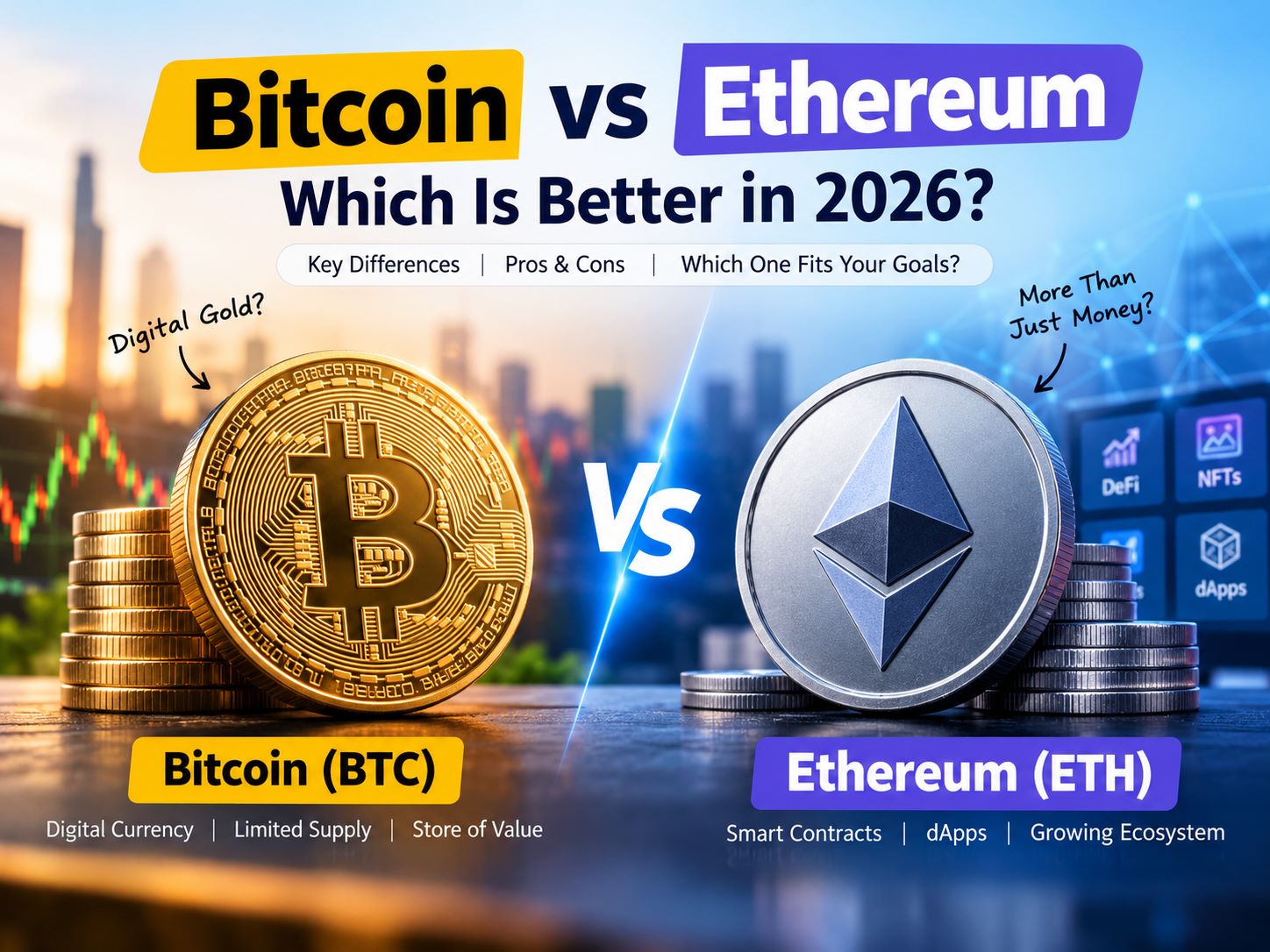
Bitcoin VS Ethereum can be confusing, especially for new cryptocurrency investors. Both are major blockchain projects; both can rise or fall sharply in value, and both attract investors looking for long-term opportunities. However, they solve different problems.
Bitcoin vs Ethereum comes down to what you want from a cryptocurrency investment. Bitcoin is primarily designed as a decentralized digital currency with a limited supply. Ethereum is a programmable blockchain that supports smart contracts, decentralized applications, and digital assets. What Is Dollar-Cost Averaging? A Smarter Investing Strategy
For investors in the USA and UK, the better choice depends on risk tolerance, investment goals, fees, security practices, and belief in each network’s future. Neither coin is guaranteed to deliver a profit, and the price of either can fall significantly.
What Is Bitcoin?
Bitcoin (BTC) is a decentralised digital currency launched in 2009. It allows people to transfer value over the internet without relying on a central bank to operate the network.
Bitcoin’s monetary policy is one of its best-known features. Its protocol limits the total supply to 21 million BTC. New bitcoin enters circulation through mining rewards, which decrease over time through scheduled halvings.
Some investors view Bitcoin as a potential long-term store of value because of its limited supply and decentralised design. Others use it to transfer money or gain exposure to the cryptocurrency market.
However, limited supply does not automatically create demand. BTC vs ETH market price depends on buyers, sellers, liquidity, investor confidence, regulation, and wider economic conditions.
Key Features of Bitcoin
- Limited supply: The protocol caps issuance at 21 million BTC.
- Proof of work: Miners use computing power to help secure the network and confirm transactions.
- Decentralized operation: The network operates without a central company controlling every transaction.
- Digital value transfer: Bitcoin can be sent across borders without a traditional bank acting as the network operator.
- Investment exposure: Bitcoin vs Ethereum investment can buy BTC directly or consider eligible investment products where available.
Bitcoin is relatively focused in its purpose compared with Ethereum. That simplicity appeals to investors who want exposure to a digital asset without needing to interact with a broad range of blockchain applications.
Still, Bitcoin is not a savings account. It does not promise interest, and its market price can decline sharply.
What Is Ethereum?
Ethereum is a decentralized blockchain launched in 2015. Unlike Bitcoin, it was designed to support programmable agreements known as smart contracts.
Its native cryptocurrency is Ether (ETH). People often use the terms Ethereum and ETH interchangeably, but they mean different things: Ethereum is the network, while ETH is the asset used within that network.
ETH pays transaction fees, helps secure Ethereum through staking, and is used throughout applications built on the blockchain. These include decentralized finance (DeFi), digital collectibles, tokenized assets, and other blockchain-based services.
Ethereum moved from proof of work to proof of stake in September 2022. Under proof of stake, validators help process transactions and secure the network by staking ETH. Eligible participants may earn rewards, but staking involves risks and is not a guaranteed source of income.
Key Features of Ethereum
- Smart contracts: Programmable agreements can execute when their conditions are met.
- Decentralized applications: Developers can build financial services and other applications on the network.
- Staking: Eligible ETH holders can participate directly or through staking services, depending on the method used.
- Transaction fees: Users pay gas fees to carry out operations on the network.
- Broader utility: ETH supports activity across a large ecosystem of blockchain applications.
Ethereum’s wider range of uses creates opportunities, but it also introduces additional complexity. Application bugs, smart-contract exploits, network congestion, and risks from third-party protocols can affect users.
Bitcoin vs Ethereum: Key Differences in 2026
The main difference is purpose. Bitcoin focuses on decentralized digital money, while Ethereum provides infrastructure for programmable blockchain applications.
| Feature | Bitcoin (BTC) | Ethereum (ETH) |
|---|---|---|
| Main purpose | Digital currency and potential store of value | Programmable blockchain and digital asset ecosystem |
| Launch year | 2009 | 2015 |
| Supply policy | Maximum of 21 million BTC | No fixed maximum supply cap |
| Consensus mechanism | Proof of work | Proof of stake |
| Network security | Mining and proof of work | Validators and staked ETH |
| Smart contracts | Limited scripting capabilities | Extensive smart-contract functionality |
| Staking | No native protocol staking | Native staking is available |
| Network fees | Transaction fees vary with demand and transaction conditions. | Gas fees vary with network demand and transaction complexity. |
| Main investment thesis | Bitcoin long-term investment: Adoption, scarcity, and demand for BTC | Adoption of Ethereum, ETH utility and network activity |
| Major additional risks | Mining economics, market concentration, and volatility | Smart contract, staking, protocol, and ecosystem risks |
The table describes structural differences, not a ranking of investment returns. Actual performance depends on market conditions and the price paid.
Which Is Better to Buy in 2026?
There is no universal winner. Consider what you expect the asset to do and which risks you can reasonably accept.
Bitcoin May Suit Investors Who Prefer Simplicity
Bitcoin may be worth researching if your main interest is exposure to a decentralized digital currency with a clearly defined supply limit.

Its investment case is often built around several ideas:
- More individuals and institutions may choose to hold BTC.
- Its fixed maximum supply may appeal to investors concerned about monetary expansion.
- Its relatively focused purpose may be easier for beginners to understand.
- A longer operating history may give investors more information about its behavior across market cycles.
These points are reasons some Ethereum staking rewards investors favor Bitcoin, not proof that it will rise in price. Demand could weaken, regulations could change, and investors could lose a substantial part of their investment.
Ethereum May Suit Investors Interested in Blockchain Applications
Ethereum may be more relevant if you believe programmable blockchain technology will support growing activity in finance, digital assets, and other online services.
Its investment case includes:
- Demand for ETH to pay network fees.
- Participation in staking, subject to the method and associated risks.
- Adoption of Ethereum-based applications and infrastructure.
- Potential demand arising from activity across the Ethereum ecosystem.
However, greater utility does not automatically mean greater returns for ETH holders. Network usage, competing blockchains, protocol changes, and the economics of fees and token issuance all matter.
A Simple Example: Investing $1,000
Suppose you have $1,000 to invest and are comparing BTC with ETH. To illustrate the effect of volatility, imagine either investment falls by 40%.
| Investment | Starting amount | Value after a 40% fall | Loss |
|---|---|---|---|
| Bitcoin | $1,000 | $600 | $400 |
| Ethereum | $1,000 | $600 | $400 |
This is a hypothetical example, not a forecast of either asset’s performance. It shows why your ability to tolerate losses matters more than choosing a coin based on headlines.
If an investment falls by 40%, it must rise by approximately 66.7% from its reduced value to return to its original value before fees and taxes.
Before investing, ask yourself whether you could handle a large decline without needing to sell to pay essential expenses.
Bitcoin vs Ethereum: Pros and Cons
Pros Bitcoin
- A clearly defined maximum supply of 21 million BTC.
- A relatively focused purpose that is straightforward to explain.
- A long operating history compared with most cryptocurrencies.
- Broad recognition among cryptocurrency investors.
- No dependence on staking rewards to support its basic investment case.
Cons Bitcoin
- No guaranteed income or interest for simply holding BTC.
- Significant price volatility and potential for large losses.
- Proof-of-work mining consumes substantial energy.
- Transaction costs and confirmation times can vary.
- A limited supply does not guarantee increasing demand or value.
Ethereum Pros
- Supports smart contracts and decentralized applications.
- ETH has practical uses in network transactions and staking.
- Supports a broad ecosystem of digital assets and financial applications.
- Proof of stake uses substantially less energy than proof of work.
- Its technology can support use cases beyond simple value transfers.
Ethereum Cons
- Gas fees can rise during periods of high demand.
- Smart contracts and decentralized applications may contain vulnerabilities.
- Staking can involve lock-up, liquidity, provider, and technical risks.
- Competition from other blockchain networks may affect adoption.
- ETH’s supply and value depend on more factors than a fixed supply cap alone.
Fees and Costs: Bitcoin vs Ethereum
Bitcoin vs Ethereum risks: Buying either cryptocurrency involves more than its displayed market price. Your total cost may include trading fees, spreads, deposit or withdrawal fees, and network transaction charges.
Bitcoin Costs
Buying BTC on an exchange may involve a trading commission or a difference between the quoted buying and selling prices. Moving BTC to a personal wallet can involve a network fee that varies with transaction demand and the transaction’s characteristics.
Bitcoin or Ethereum which is better base network does not pay staking rewards. Services advertising returns on BTC may lend, invest, or otherwise use your assets, creating additional counterparty risk.
Ethereum Costs
Buying ETH can involve the same types of exchange fees and spreads. Sending ETH or interacting with an application on Ethereum’s main network also requires gas.
Gas fees change with network demand and the complexity of the transaction. Some activities, such as swapping tokens through a smart contract, can cost more than a simple transfer. Layer 2 networks may offer different costs, but they introduce their own operational and security considerations.
Staking may generate rewards, but the net result depends on validator or provider charges, network conditions, the price of ETH, and any risks or restrictions associated with the service.
Important: Exact exchange fees and live network costs change frequently. Check the fee schedule and estimated transaction cost immediately before trading or transferring funds rather than relying on an outdated price table.
Is Bitcoin Safer Than Ethereum?
Neither asset is safe in the same way as cash held in an insured bank account. Both can experience major price declines, and ownership does not guarantee that you can sell at your preferred price.
Bitcoin has a relatively narrow protocol purpose, but it still carries market, custody, technical, and regulatory risks. Ethereum’s additional functionality creates a wider range of potential uses and a wider range of application-related risks.
Your storage method matters, too. Keeping assets on an exchange exposes you to the exchange’s operational and custody risks. Holding them in a personal wallet gives you more direct control but makes you responsible for protecting your private keys and recovery phrase.
For safer handling:
- Use a reputable platform that is legally available in your jurisdiction.
- Enable multifactor authentication and use a unique password.
- Never share your seed phrase or private keys.
- Test a small transfer before moving a large amount to a new wallet.
- Avoid guaranteed-return claims and unsolicited investment offers.
- Keep records of purchases, transfers, disposals, and relevant fees.
A regulated platform does not eliminate cryptocurrency price risk, and regulatory protections differ between products and jurisdictions.
Bitcoin vs Ethereum for Long-Term Investing
Long-term investing requires more than predicting which coin will perform best over the next few months. You need a reason to hold the asset, a plan for managing risk and an understanding of what could undermine your investment thesis.
Think About Adoption, Not Just Price
For Bitcoin, consider whether demand for a decentralised digital asset could remain strong over time. For Ethereum, consider whether developers, users and businesses will continue to use its network and whether that activity supports demand for ETH.
Neither thesis is certain. Strong technology does not automatically translate into higher token prices, and past price increases do not guarantee future gains.
Consider Your Time Horizon
Money needed for rent, bills, emergencies, or a near-term purchase generally should not be exposed to highly volatile assets. Even investors with a long time horizon need to consider how much of their portfolio they can afford to lose.
Understand the Role of Diversification
Owning BTC and ETH together can spread exposure across two different blockchain ecosystems, but it does not remove cryptocurrency-market risk. Their prices can fall at the same time, especially during broad market sell-offs.
For many investors, the priority should be an emergency fund, manageable debt, and a diversified financial plan before taking on speculative cryptocurrency exposure.
Bitcoin vs Ethereum for Beginners in the USA and UK
Where you live affects the platforms available to you, the products you can access, and the way you report taxable transactions.
For US Investors
The Internal Revenue Service generally treats digital assets as property for federal tax purposes. Selling cryptocurrency, exchanging one asset for another, or using it to pay for something can create a reportable tax event. Income from certain digital-asset activities may also be taxable. Should I buy Bitcoin or Ethereum?
Read the IRS digital assets guidance and keep transaction records.
For UK Investors
HM Revenue & Customs says that selling, exchanging or using cryptoassets to pay for goods or services can count as a disposal for Capital Gains Tax purposes, depending on the circumstances. Receiving crypto through staking or other activities can have different tax treatment.
Read the HMRC guidance on selling cryptoassets and guidance on receiving cryptoassets.
Tax rules can change, and your circumstances matter. Seek qualified tax advice if you have significant transactions, staking income or cross-border tax obligations.
How to Choose Between BTC and ETH
Before making a decision, work through these five steps:
- Define your goal. Decide whether you want exposure primarily to digital money or to a programmable blockchain ecosystem.
- Set a loss limit. Choose an amount that would not affect essential spending if its market value fell sharply.
- Compare total costs. Check the exchange’s trading spread, commissions, transfer fees and any relevant staking charges.
- Review custody. Understand how the platform or wallet protects your assets and what happens if you lose access.
- Write down your investment thesis. Identify the developments that would support your decision and the evidence that would make you reconsider it.
Do not buy either asset simply because its price has recently risen or someone online predicts a large return. A clear plan is more useful than a confident price prediction.